
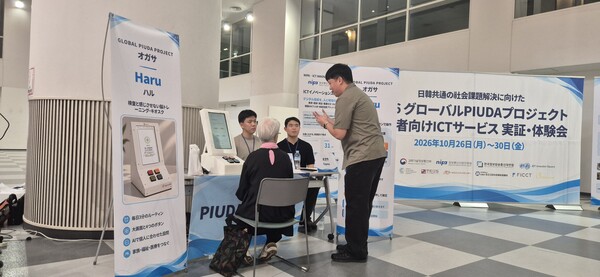
South Korea's National IT Industry Promotion Agency (NIPA) said on Oct. 27 it began on-site verification at the Asia-Pacific Trade Center (ATC) in Osaka, Japan, together with the Ministry of Science and ICT, of outstanding developments from the "2026 Global PIUDA Project".
The Global PIUDA Project is a software development competition linked to the ICT Innovation Square programme in five regions nationwide. It identifies outstanding developments to solve social and public issues and supports on-site verification in South Korea and overseas as well as service advancement.
From this year, on-site verification expanded to Japan. The verification runs for three days through Oct. 29 in cooperation with local institutions including Osaka University and the ATC Ageless Center. Older Japanese people, their families, and care and welfare workers will directly try and evaluate South Korean-developed services.
The six items to be verified are Ogasat team's brain-activity kiosk "Haru"; Deep Labs team's AI storybook service "Story Tailor"; Inner Loop team's daily life and memory recording service "Ear"; Green Uncles team's voice-based care record service "Care Navigator"; Easy Dance team's AI motion-recognition-based health exercise service "Easy Dance"; and Allfit team's AI rehabilitation exercise platform "Rycle".
The development teams will check ease of operation, the appropriateness of Japanese-language guidance, service preference and the potential for use in care settings, based on local user experiences and interviews. They will also gather opinions from families and care workers to identify improvements needed in real living environments.
Based on the verification results, NIPA will supplement each service's functions, usability, stability and level of localisation. It plans to reflect confirmed improvements in domestic services as well and support linking practical use and commercialisation so outstanding developments can be used in actual care settings.
A NIPA official said, "Through cooperation between South Korea and Japan, we will contribute to solving common social issues such as elder care, and we will actively support outstanding developments so they can spread to domestic and overseas markets."
 Jin-ho Lee
jhlee26@d-today.co.kr