
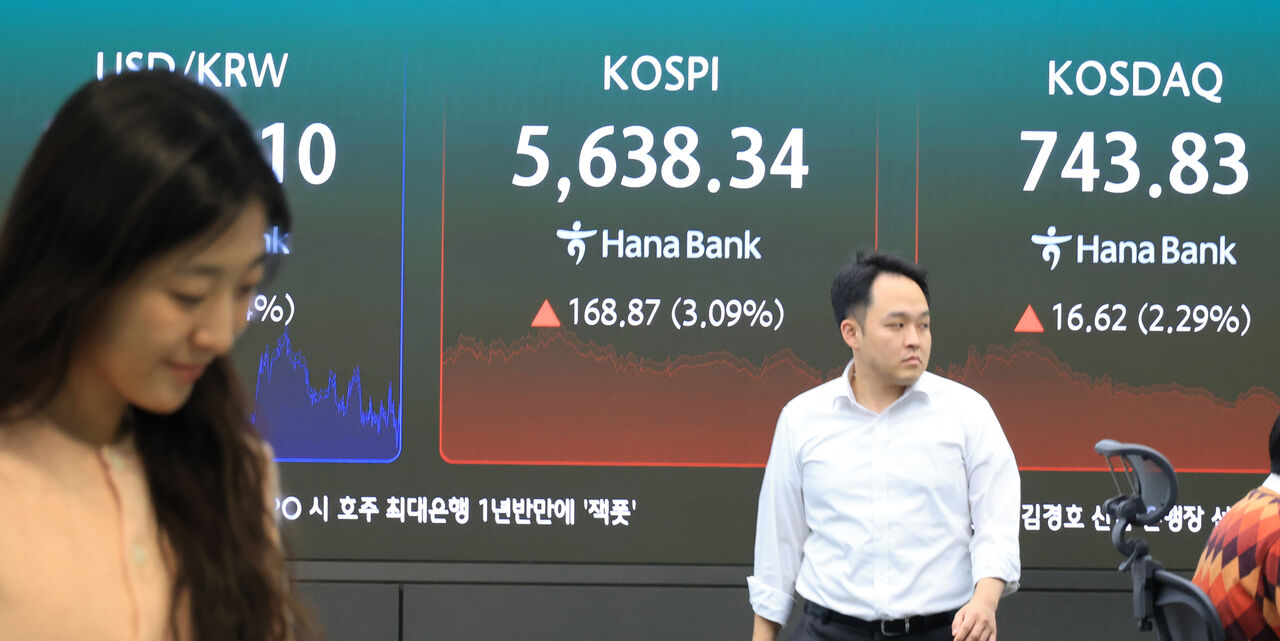
South Korea's KOSPI rose more than 3 percent and reclaimed the 5,630 level on joint buying by foreign investors and institutions. It briefly climbed above 5,700 during the session but gave up part of its gains in the afternoon.
On Oct. 27, the KOSPI ended up 168.87 points, or 3.09 percent, at 5,638.34. It opened at 5,658.65 and rose to as high as 5,737.61 as buying surged early in the session.
A buy-sidecar was triggered in the morning, temporarily halting the effectiveness of program buy orders as KOSPI200 futures surged. The index later pared some gains as profit-taking emerged.
By investor type, foreigners and institutions net bought 592.9 billion won and 282.0 billion won, respectively, leading the rise. Retail investors net sold 949.4 billion won.
Among the top market-cap stocks, semiconductor shares posted notable gains.
Samsung Electronics ended up 4.23 percent at 222,000 won, while SK Hynix rose 5.18 percent to 1,341,000 won.
SK Square rose 7.67 percent to close at 828,000 won, and Samsung Electro-Mechanics gained 7.42 percent to end at 1,201,000 won. LG Energy Solution rose 2.00 percent, Hyundai Motor gained 0.87 percent, KB Financial Group added 0.27 percent and Samsung Life climbed 3.45 percent.
Samsung Biologics, meanwhile, fell 5.37 percent to end at 1,374,000 won.
The KOSDAQ also rose. It ended up 16.62 points, or 2.29 percent, at 743.83. It rose more than 4 percent early in the session but pared gains in the afternoon.
In Seoul's foreign exchange market, the won-dollar exchange rate stood at 1,324.60 won, down 2.40 won from the previous session.
In the domestic market, improved investor sentiment was influenced by a recovery in investment sentiment toward U.S. artificial intelligence and semiconductor shares and expectations of easing tensions in the Middle East. Bargain hunting flowed mainly into large-cap semiconductor shares that had undergone a sharp recent correction, widening the KOSPI's rebound.
Still, the domestic market has continued to show high volatility recently, repeatedly swinging sharply around the 5,500 level. The index also rose above 5,700 during the session before giving up some gains, showing a lack of clear direction.
Han Ji-young (한지영), a researcher at Kiwoom Securities, said, "In the recent correction phase, the share-price instability of U.S. AI stocks has been easing, and the KOSPI earnings consensus is also being maintained without any particular damage." Han added, "At this point, rather than further reducing stock exposure, there is a need to prioritize maintaining existing positions to reflect an improvement in the resilience of earnings outlooks and the possibility of a share-price rebound."
 Sang-yeop Oh
yub@d-today.co.kr