
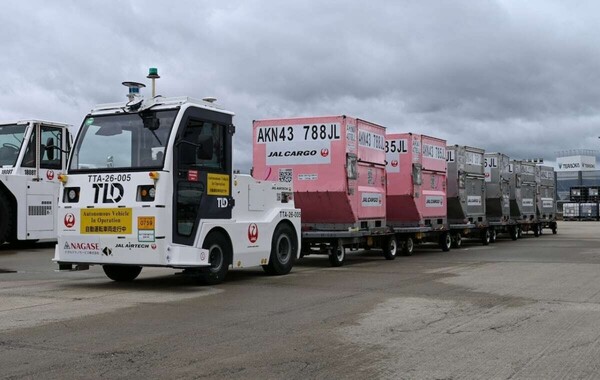
[DigitalToday reporter Jinju Hong] Japan's Fukuoka Airport has introduced Level 4 autonomous driving for towing tractors that carry air cargo containers. The system transports cargo without a driver on designated sections inside the airport, aiming to address labor shortages on site and improve work efficiency and safety.
On Oct. 27 (local time), ITmedia reported that Japan Airlines (JAL) and Fukuoka Airport operator Fukuoka International Airport began Level 4 autonomous operations in the airport's cargo transport section from Oct. 26. Level 4 is an autonomous driving stage in which the system controls the vehicle within defined operating conditions and areas.
The section where autonomous driving is applied runs from an air cargo consolidation area inside the airport to aircraft parked in the domestic terminal area. Of the total travel distance of about 2.5 km, 1.7 km is operated autonomously.
The vehicle in operation is a towing tractor that moves air cargo containers. It connects six carts to a single tractor and moves along a preset route. The approach applies autonomous driving to repetitive cargo transport work to automate the process.
Fukuoka Airport is the third airport in Japan to introduce Level 4 autonomous driving, following Narita Airport and Haneda Airport. Japan Airlines and Fukuoka International Airport started operations with one vehicle and aim to expand to a total of four by the end of this year.
A key factor behind the introduction is a labor shortage at airport work sites. Japan Airlines expects autonomous driving to reduce the burden of long hours of outdoor work and allow some staff to be reassigned to indoor duties.
Miho Saruwatari (猿渡美穂), head of Japan Airlines' Kyushu branch, said, "In a situation of labor shortages, it is urgent to support operations through automation and optimize workforce allocation while reducing on-site burdens."
Etsuya Uchiyama (内山悦也), head of the airport operations headquarters at Fukuoka International Airport, said, "It will contribute to airport safety by boosting work efficiency while reducing human error that can occur in manual driving."
Airport ground handling involves many tasks that repeatedly transport cargo and baggage around aircraft. With travel routes and work areas relatively clear, it is considered a field where autonomous driving technology can be applied. In environments where it is difficult to secure sufficient staff, automating repetitive transport work can help make more efficient use of limited manpower.
Fukuoka Airport plans to expand its operating system by gradually increasing the number of autonomous vehicles. Whether stability in real operations, improved work efficiency and the effects of workforce reassignment are confirmed is expected to be key to any additional rollout.
 Jinju Hong
hongjj@d-today.co.kr