
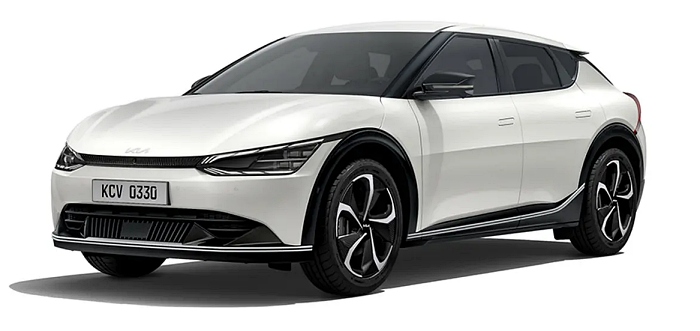
[Digital Today reporter Jinju Hong] Kia has frozen the price of its 2027 model-year electric crossover EV6. The starting price is $37,900, more than $8,000 higher than the newly launched, lower-priced electric SUV EV3. Kia instead aims to differentiate the EV6 with a larger body, longer driving range and faster charging performance.
Electrek, an electric-vehicle-focused outlet, reported on Oct. 27 local time that Kia kept prices for all trims of the 2027 EV6 at the same level as the previous model year. The model is a year-change update that carries over the existing lineup without major changes. Kia cut the price of the 2026 EV6 by $5,000 earlier and has now kept the new model’s price unchanged.
The base EV6 Light Standard Range rear-wheel-drive model starts at $37,900, excluding a $1,545 destination fee. It has a 63 kWh battery and can travel up to 237 miles under U.S. Environmental Protection Agency standards.
Consumers focused on long-distance driving can choose higher trims. The EV6 Light Long Range rear-wheel-drive model, with an 84 kWh battery, starts at $41,200 and offers up to 319 miles of range. The all-wheel-drive model can travel up to 295 miles, and the top GT-Line all-wheel-drive model up to 270 miles.
Kia’s new lower-priced electric SUV EV3 instead highlights price competitiveness. The EV3 Light front-wheel-drive model starts at $29,890, $8,010 cheaper than the base EV6. It has a 58.3 kWh battery and a maximum single-charge range of 221 miles.
The EV3 comes in 5 trims: Light, Wind, Land, GT-Line and GT. Higher trims, including Wind, Land, GT-Line and GT, have an 81.4 kWh battery, and some configurations offer up to 321 miles of range. The structure lowers the entry barrier to buying an EV with the lower-priced EV3, while the EV6 seeks differentiation in body size and charging performance.
The two models share interior convenience features. Both have Kia’s next-generation infotainment system, ccNC, and offer a panoramic display combining a 12.3-inch instrument cluster and central navigation screen with a 5-inch climate control screen. Tesla’s North American Charging Standard (NACS) port is also standard, allowing use of Tesla Superchargers without a separate adapter.
The difference stands out in charging speed. The EV6 uses an 800-volt electrical system and takes about 18 minutes to charge from 10 percent to 80 percent. The EV3, which uses a 400-volt system, needs about 30 minutes for the same charging range. Actual time may vary depending on charging conditions, but the EV6 has an advantage in reducing charging time during long-distance driving.
The EV6 is also larger. The EV6 is 184.8 inches long and 74 inches wide, with a wheelbase of 114.2 inches. The EV3 is relatively smaller, at 169.3 inches long and 72.8 inches wide, with a wheelbase of 105.5 inches. The EV3 can be an option for consumers who value city driving and lower cost burden, while the EV6 can be an option for consumers who want a wider body and faster charging performance.
Kia is also offering discounts to sell existing inventory. It is applying customer cash discounts of $10,000 for the 2026 EV9, $5,000 for the 2026 EV6 and $1,500 for the 2027 EV3. Actual purchase prices and applicable conditions may vary by time of sale, region and dealer.
With this pricing policy, Kia’s North American EV lineup has more clearly separated the EV3 as an entry model and the EV6 as a higher crossover with strengthened charging performance and body size. For EV buyers, it is necessary to compare not only initial purchase costs but also driving range, charging time and body size when choosing a model.
 Jinju Hong
hongjj@d-today.co.kr