
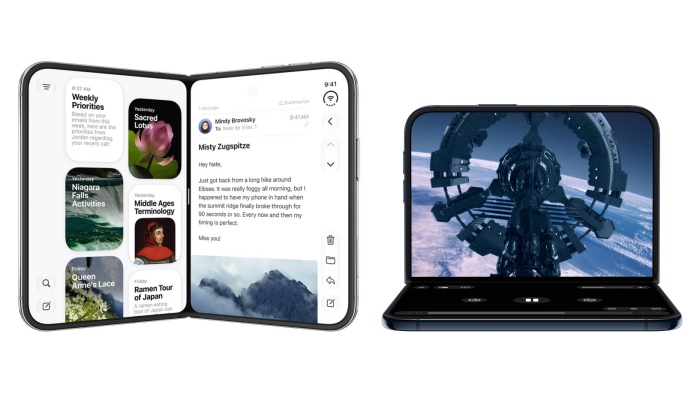
How would Apple’s first foldable phone, the iPhone Duo, stack up against Samsung Electronics’ Galaxy Z Fold 8? The two devices are at a similar level in screen size and core performance, but showed clear differences in display creases, durability, portability and software use.
On Oct. 26, IT outlet TechRadar compared the two products and said the iPhone Duo showed strengths in crease suppression, water and dust resistance, and pen support. It rated the Galaxy Z Fold 8 ahead on lighter weight, thinner design and more polished multitasking features.
Both devices have the same 7.6-inch internal display, and their cover screens are similar at 5.4 inches for the iPhone Duo and 5.5 inches for the Galaxy Z Fold 8. Their rear cameras also show little difference in basic setup, with 48-megapixel wide and ultra-wide units for the iPhone Duo and 50-megapixel wide and ultra-wide units for the Galaxy Z Fold 8.
The most noticeable difference is the display crease, a chronic issue for foldable phones. The iPhone Duo applies a nano-texture coating to scatter light and is designed to make the crease less visible. TechRadar explained that the crease has not disappeared completely, but is relatively hard to see in actual use.
The Galaxy Z Fold 8, by contrast, was rated as having a more noticeable vertical crease on the internal display in bright environments. In hinge design, the iPhone Duo emphasized a flat shape when unfolded and a smooth finish.
On durability, the iPhone Duo came out ahead. The iPhone Duo supports an IP68 rating, while the Galaxy Z Fold 8 applies an IP48 rating. IP68 is a rating that provides protection against dust ingress and protection against immersion in fresh water, making it more advantageous than IP48 in dust protection. Actual water resistance can vary depending on manufacturer-set test conditions and the use environment.
Samsung Electronics held the edge on portability. The Galaxy Z Fold 8 weighs 201 grams, 53 grams lighter than the 254-gram iPhone Duo. It is also 4.5 mm thick when unfolded and 9.7 mm when folded. The iPhone Duo is thicker at 5.2 mm and 11.3 mm, respectively.
Those differences also affect the real carrying experience. The Galaxy Z Fold 8 is seen as relatively less burdensome in a pocket, while the iPhone Duo can feel heavier and thicker. If a user carries a foldable phone daily or spends a long time using it one-handed, weight and thickness can be key selection criteria.
Pen support was cited as a point of differentiation for the iPhone Duo. The Galaxy Z Fold 8 does not support S Pen-type input after excluding the digitizer layer to reduce thickness. The iPhone Duo, by contrast, can use the Apple Pencil USB-C model, allowing the large internal display to be used for writing, notes and simple tasks.
It does not support attaching the Apple Pencil to the device for charging. Having to charge and pair it separately was described as a downside.
On software, Samsung Electronics was a step ahead. The Galaxy Z Fold 8 can place two apps side by side on the screen and add a floating window, allowing up to three apps to be used at the same time. It is a configuration that is advantageous for handling multiple tasks while switching between them.
The iPhone Duo supports split-screen multitasking based on iOS 27, but it can display only up to two apps at once. There are also limitations on running the same app side by side. TechRadar analysed that while Samsung has already refined much of the software experience for large-screen devices, Apple has room to further develop screen layouts and usability.
Performance was rated at the top level for both devices. The iPhone Duo uses the A20 Pro, while the Galaxy Z Fold 8 is equipped with the Qualcomm Snapdragon 8 Elite 5th Gen for Galaxy. According to the comparison materials provided, both chips are based on a 2-nanometre process, and battery capacity is also at a similar level in the 4,800 mAh range.
In benchmarks, Apple was slightly ahead, but both devices showed strong performance in everyday tasks such as video editing, gaming, web browsing and multitasking. As a result, factors such as weight, software and usage environment may be more important purchase criteria than minor differences in processor performance.
The camera differed more in the internal selfie camera than in the rear camera. The Galaxy Z Fold 8 places a 10-megapixel internal camera in a hole-punch design, while the iPhone Duo uses a 4-megapixel camera hidden under the pixels. The iPhone Duo reduced elements that block the screen, but was rated as leaving something to be desired in image quality.
Biometric authentication also differs. The iPhone Duo offers Touch ID instead of Face ID. Users accustomed to face-unlock may need to consider the difference in how it is used.
The iPhone Duo starts at $1,999 for the 256GB model, or about 2.64 million won. The Galaxy Z Fold 8 with the same storage capacity starts at $1,899, or about 2.51 million won, making Samsung’s product about $100 cheaper. Maximum storage differs, with the iPhone Duo at 2TB and the Galaxy Z Fold 8 at 1TB.
Ultimately, the competition between the two devices is closer to a contest of different strengths than a one-sided advantage for either side. The iPhone Duo may be appealing if reducing display creases and prioritising water and dust resistance and pen use. The Galaxy Z Fold 8 may be a more suitable choice if a user prioritises a light, thin device and large-screen use such as running multiple apps.
TechRadar also analysed that rather than naming a clear winner and loser, the choice could vary depending on user priorities. It shows that in the foldable phone market, the focus of competition is expanding beyond simple screen size to portability, durability and software completeness.
 Jinju Hong
hongjj@d-today.co.kr