
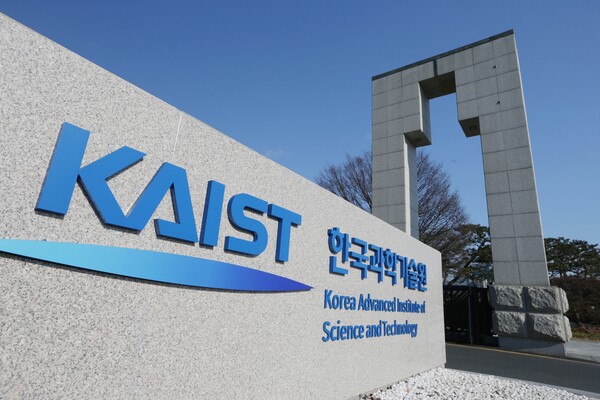
Early admissions competition for the 2027 academic year at four institutes of science and technology, including the Korea Advanced Institute of Science and Technology (KAIST), hit an all-time high. Applicant numbers also rose 36.5 percent from a year earlier, showing stronger interest in science and engineering majors.
Data submitted by KAIST, the Ulsan National Institute of Science and Technology (UNIST), the Gwangju Institute of Science and Technology (GIST) and the Daegu Gyeongbuk Institute of Science and Technology (DGIST) to Hwang Jung-a (황정아), a Democratic Party lawmaker on the National Assembly’s Science, ICT, Broadcasting and Communications Committee, showed 33,349 people applied for 2,067 undergraduate early-admissions places for the 2027 academic year.
The competition rate was 16.1 to 1. It was the highest since the 2014 academic year, when all four institutes began running early admissions. Applicant numbers rose by 8,926, or 36.5 percent, from 24,423 a year earlier, the highest on record.
By institution, DGIST had the highest competition rate at 28.6 to 1. It attracted 9,208 applicants for 322 places. UNIST drew 11,211 applicants for 565 places, for a competition rate of 19.8 to 1. It was the first time since its founding that UNIST early-admissions applicants exceeded 10,000.
KAIST received 8,394 applications for 865 places, for a competition rate of 9.7 to 1. That was up 1.2 points from 8.5 to 1 a year earlier. GIST logged a competition rate of 14.4 to 1, with 4,536 applicants for 315 places. GIST posted a record number of applicants despite increasing its intake by 100 from a year earlier.
KAIST recorded its highest competition rate across 42 academic years since it first recruited its undergraduate intake for the 1986 academic year. UNIST and DGIST also posted their highest competition rates since their first undergraduate recruitment for the 2009 and 2014 academic years, respectively.
Total early-admissions applicants for the four institutes more than doubled in four years, rising to 33,349 for the 2027 academic year from 15,443 for the 2023 academic year. Some interpretations say this could be a sign that preference for medical schools is easing and demand for science and engineering majors is expanding.
Hwang said, "The fact that early-admissions competition at the four institutes hit a record high and applicants also reached a record shows a clear signal that more students are moving toward science and engineering." She added, "The National Assembly will also do its part to build a stronger growth ladder in science and engineering, including military service alternatives for science and engineering, improving researchers’ treatment and support for deep-tech startups."
 Jin-ho Lee
jhlee26@d-today.co.kr