
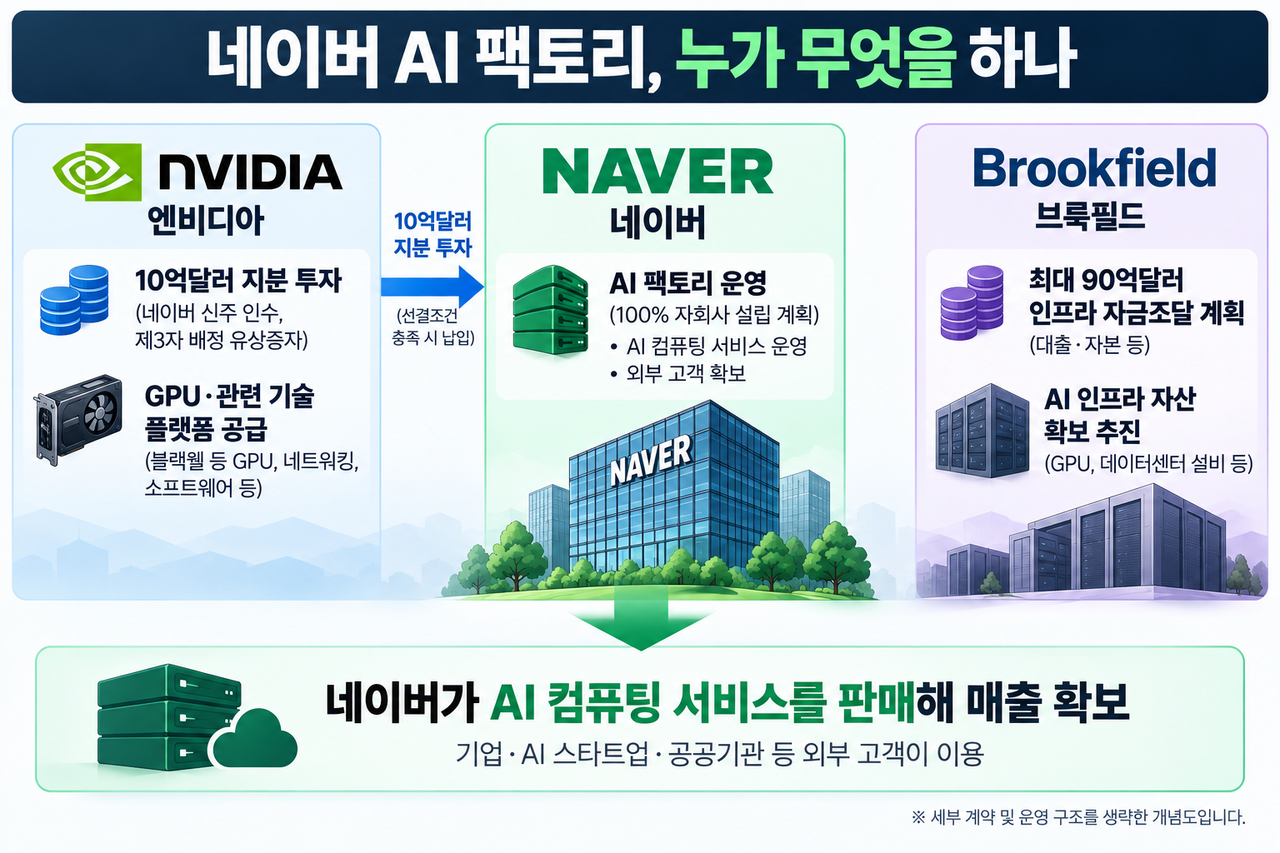
With Nvidia's equity investment payment of about 1.5 trillion won approaching, Naver's AI Factory project has been put to the test. To receive the funds, it must meet a prerequisite including securing computing infrastructure worth at least $9 billion. The task then is to turn the large investment plan into actual revenue through external customer contracts and service launches.
A paid-in capital increase filing Naver submitted in July shows Nvidia plans to invest $1 billion in Naver. The planned amount to be raised, applying the exchange rate at the time of the filing, is about 1.48 trillion won. The offering price for new shares is 204,500 won per share, and the scheduled payment date is Oct. 30. The final number of shares to be issued and the amount to be raised in won will be confirmed by applying the exchange rate on the reference date set in the contract.
The investment is aimed at expanding Naver's business beyond its platform operations centred on search, advertising and commerce into the AI infrastructure market. As demand rises for high-performance graphics processing units (GPUs) needed to develop AI models and run services, Naver plans to use its experience operating data centres and its cloud technology to secure a new business-to-business revenue source.
CONDITION IS SECURING $9 BILLION IN INFRASTRUCTURE
Naver set Oct. 30 as the scheduled payment date in its paid-in capital increase filing. The schedule may be extended depending on whether it meets prerequisites including securing computing infrastructure of at least $9 billion.
To that end, Naver signed a non-binding preliminary agreement on July 22 with global alternative investment firm Brookfield for infrastructure financing of up to $9 billion. It selected Brookfield as the exclusive preferred negotiating party and has pushed talks to sign a formal contract.
Under a business structure proposal Naver disclosed, Brookfield plans to raise up to $9 billion via a special purpose vehicle (SPV) after signing the main contract and to secure infrastructure assets such as GPUs and data-centre facilities. Nvidia will supply GPUs and related technologies, and Naver will run the AI computing business.
Naver plans to establish a separate operating company that it will wholly own to provide AI computing resources to external companies and institutions. The operating company will receive computing resources from the SPV and pay usage fees, while selling services to external customers to generate revenue. The SPV would also earn profits by supplying infrastructure.
The structure is designed to reduce Naver's initial funding burden from buying both GPUs and data-centre facilities directly. Specific cost-sharing and accounting treatment may vary depending on the final contract terms.
Naver plans to begin operating infrastructure with a capacity of 55 megawatts at its Sejong hyperscale data centre, Gak Sejong, in the first half of 2027. It aims to expand to 100 MW by the end of that year and to 200 MW in 2028. This corresponds to phase one of its longer-term plan to build a gigawatt-scale AI Factory.
THE NEXT HURDLE IS CUSTOMER CONTRACTS; 2027 REVENUE SEEN AT 1 TRILLION WON
After financing, the task to resolve is securing customers. AI Factory is a business that provides computing resources such as GPUs to companies and others and charges usage fees. Even if infrastructure buildout expands, it would be difficult to improve profitability without securing customers that use the service.
Naver plans to secure initial demand by tapping global large customers, Nvidia's business ecosystem, and its existing base of corporate and public-sector clients.
The securities industry sees Naver as negotiating to diversify contract periods and supply volumes across multiple customers, rather than pursuing a long-term contract with a single large customer that the market initially expected. The analysis is that it could raise initial utilisation rates and profitability while reducing dependence on a specific customer.
Kim Dong-woo (김동우), an analyst at Kyobo Securities, said he assesses that Naver is "in the process of negotiating with multiple customers to secure a more advantageous contract mix than a long-term contract with a single customer." He judged that while the customer contract announcement is later than market expectations, the business schedule itself has not been delayed.
Specific customers, supply volumes and contract terms have not been disclosed. When contract details take shape, it is expected to make it possible to judge AI Factory's projected revenue and profitability more clearly.
There is also expectation for early-stage revenue. Naver said in its Aug. 2 second-quarter earnings release that it expects AI Factory-related revenue to arise from the first half of 2027. Some brokerages forecast AI Factory-related revenue in 2027 at about 1 trillion won.
There are differences over the timing for reflecting the results. Some expect revenue to arise from the second quarter of 2027, while others see it being reflected in earnest from the third quarter, considering the infrastructure buildout and service launch schedules.
Profitability is expected to take time. Naver's second-quarter revenue this year rose 16.2 percent from a year earlier to 3.39 trillion won, but operating profit fell 0.2 percent to 520.3 billion won. The securities industry expects operating profit to decline from a year earlier in the third quarter as well due to cost burdens from AI infrastructure investment, distribution of offline payment terminals and expanded shopping promotions.
Naver expects profitability may be low in the early stage of the AI Factory business, but that it will secure a double-digit operating profit margin as the business matures. Over the long term, it presented a target of an operating profit margin of more than 20 percent.
Ultimately, confirming infrastructure financing with Brookfield and Nvidia's payment-in of the investment are the first hurdles for executing the AI Factory project. The remaining task is to secure stable revenue and prove profitability through customer contracts and service launches.
Ahn Jae-min (안재민), an analyst at NH Investment & Securities, forecast that contracts with major tenant customers could be disclosed by the end of the year at the latest. He projected that once the 55 MW data centre is completed in the first half of 2027, "results could be reflected from the third quarter."
 Hojeong Lee
lhj@d-today.co.kr