
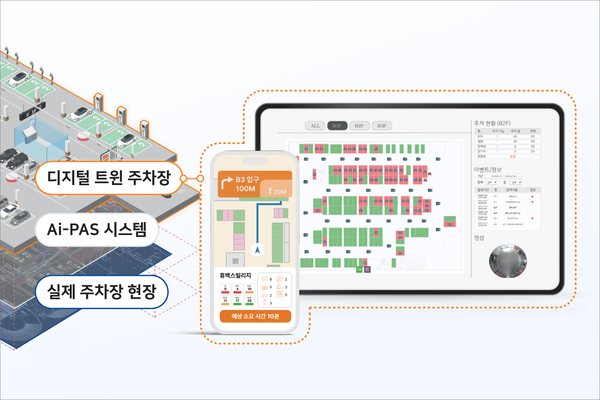
High Parking, a parking infrastructure operations subsidiary of Humax Mobility, said on Oct. 27 it built its AI-based smart video guidance system, Ai-PAS, at the car park of Ewha Womans University Seoul Hospital in Magok, Gangseo district, Seoul. High Parking applied an upgraded version of its physical AI parking technology introduced at Seoul Station, tailored to the use environment of a large hospital. High Parking operates about 1,400 car parks nationwide under the Turu Parking brand, with a total of 290,000 spaces.
The hospital car park has more than 2,000 spaces spread down to the sixth basement level. With similar layouts on each floor, first-time patients and caregivers can easily wander in search of open spots. Many patients have limited mobility, raising the share of private car use, and pick-up and drop-off as well as entry and exit concentrate in certain areas and time slots.
High Parking installed about 370 AI cameras, 80 smart electronic signs and about 20 licence-plate recognition cameras at the site. The AI cameras track vehicle movement in real time across all areas, including lanes. An AI server uses the data to assess congestion and traffic flow and guides drivers through on-site equipment such as electronic signs. It implements in the car park the structure of physical AI that perceives its surroundings, analyses and makes decisions before acting.
Hospital-specific functions were applied to bottleneck points. In the first-floor entrance stopping zone, an automatic announcement plays when a vehicle is detected staying longer than a set time. On exit, it assesses congestion by zone and guides vehicles to less crowded exits. It also applies route guidance to empty spaces and caution alerts when pedestrians approach and vehicles cross paths. Situations requiring administrator intervention are immediately sent to the operations system.
High Parking focused at Seoul Station on faster turnover for users arriving from across the country. At Ewha Womans University Seoul Hospital, it adjusted its decision algorithms and guidance methods to address congestion in the pick-up and drop-off zone and concentrated exit traffic. The company said it plans to expand services into V2I infrastructure in which autonomous vehicles and robotaxis exchange information with parking infrastructure in real time, based on data and operational know-how built up at transport hubs and medical facilities.
High Parking Chief Executive Park Jun-gyu (박준규) said, "Since a hospital car park is the first space patients and caregivers encounter, we upgraded Ai-PAS introduced at Seoul Station to fit the hospital environment so the car park can recognise situations on its own and respond." He added, "We will prepare infrastructure so hospital car parks can function conveniently in the era of autonomous vehicles and robotaxis, while reducing current parking inconvenience."
 Daegeon Seok
d2dg@d-today.co.kr