
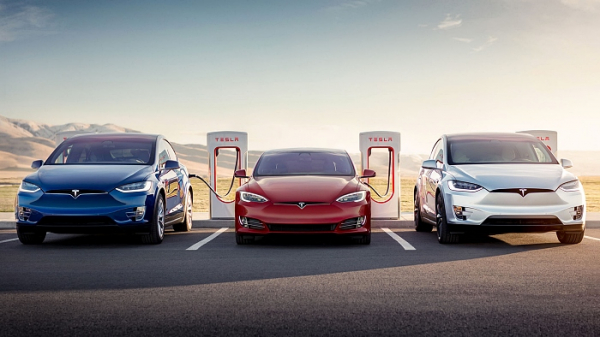
As energy storage systems (ESS) emerge as an alternative for EV charging stations with insufficient grid connection capacity, calls are growing for regulatory changes. The government’s current ESS policy and distributed energy system focus on supporting renewable energy, and do not allow electricity taken from the grid to be stored in an ESS and used for charging. The charging industry says the system itself needs to be revised, beyond demonstration exemptions, to allow EV charging stations to be combined with ESS.
According to the industry on Monday, facilities that use ESS together with chargers are not allowed to connect to the power grid and are permitted only when solar power, ESS and chargers are installed together. The explanation is that when the Special Act on the Promotion of Distributed Energy was enacted in June 2023, the role of ESS was focused on boosting renewable energy.
The Ministry of Trade, Industry and Energy’s "ESS Industry Development Strategy" released in October that year also said it would secure 3.7 gigawatts of ESS by 2030 to offset volatility from expanding renewable energy. An industry source said, "We gave opinions when the law was made, but they were not sufficiently reflected." The person said solar power requires large sites, making it difficult to place alongside charging stations in cities or highway rest areas.
The charging market has changed since then. As the number of electric vehicles has grown, demand has increased for fast charging while traveling. Data from Korea Expressway Corp shows EV charging at rest areas during the Chuseok holiday rose 4.2 times in two years. EVs on highways have virtually nowhere to charge other than rest areas, and charging demand concentrates between noon and 3 p.m. The industry says complaints are also increasing among EV users that it has become harder to charge at rest areas during holidays or weekends.
Even when operators try to install new chargers, they are often blocked at the stage of securing electricity supply. Most highway rest areas were built before EV adoption. With limited spare capacity in the power grid running south of Gyeonggi province and additional demand from data centers, many rest areas must wait 3 to 5 years to receive additional electricity. There are also cases in which rest areas that won charging business rights cannot receive power and discuss replacing them with other rest areas.
The industry says using ESS at charging stations could resolve much of the problem. Charging stations could fill ESS with grid electricity during idle times and discharge it when usage surges, allowing more vehicles to be served with the same connection capacity.
It could also store electricity during off-peak night pricing periods or times of low electricity use, helping prevent grid overload and shutdown risks. The industry believes that storing electricity when it is not being used, even if only a small amount is drawn, could partially substitute for expanding grid connection capacity. It says even if 480 kilowatt to 600 kilowatt-class or higher ultra-fast chargers are introduced in large numbers, the resulting surge in simultaneous charging power demand could be handled.
In China, charging stations are already operating that attach small ESS units to each charger to produce output higher than the connection capacity. The industry also cites the benefit of storing surplus solar power during daytime hours and diverting it to charging demand.
Even recently, the role of ESS in government policy has remained focused on renewable energy. A revision to the distributed energy law on Sept. 15 allows resident-participation renewable power projects with facility capacity of 1 megawatt or less to connect to distribution networks ahead of other operators from Dec. 16. The law includes an electricity storage and resale business that stores electricity in ESS and sells it, but has no provisions on using ESS at charging stations.
In megaprojects announced by the government, ESS was included as a means to supply power for the Honam region semiconductor cluster along with local renewable energy and combined heat and power and liquefied natural gas generation. That means a policy approach to meeting rising charging demand with ESS has not been reflected.
The industry is submitting policy proposals demanding that ESS and chargers be combined so that grid electricity can be stored and sold. According to the industry, the government has typically responded by telling them to first conduct demonstrations through a regulatory sandbox, but it is insufficient for implementation. Critics say sandbox demonstrations rarely lead to institutional changes, consuming time and money without guaranteed results.
Because the law already provides for an electricity storage and resale business, the industry believes the method of storing grid electricity and using it for charging can be extended to EV charging stations. An industry source said, "ESS that reduce fire risk, such as lithium iron phosphate batteries, are being used, so they can be attached to charging stations."
 Daegeon Seok
d2dg@d-today.co.kr