
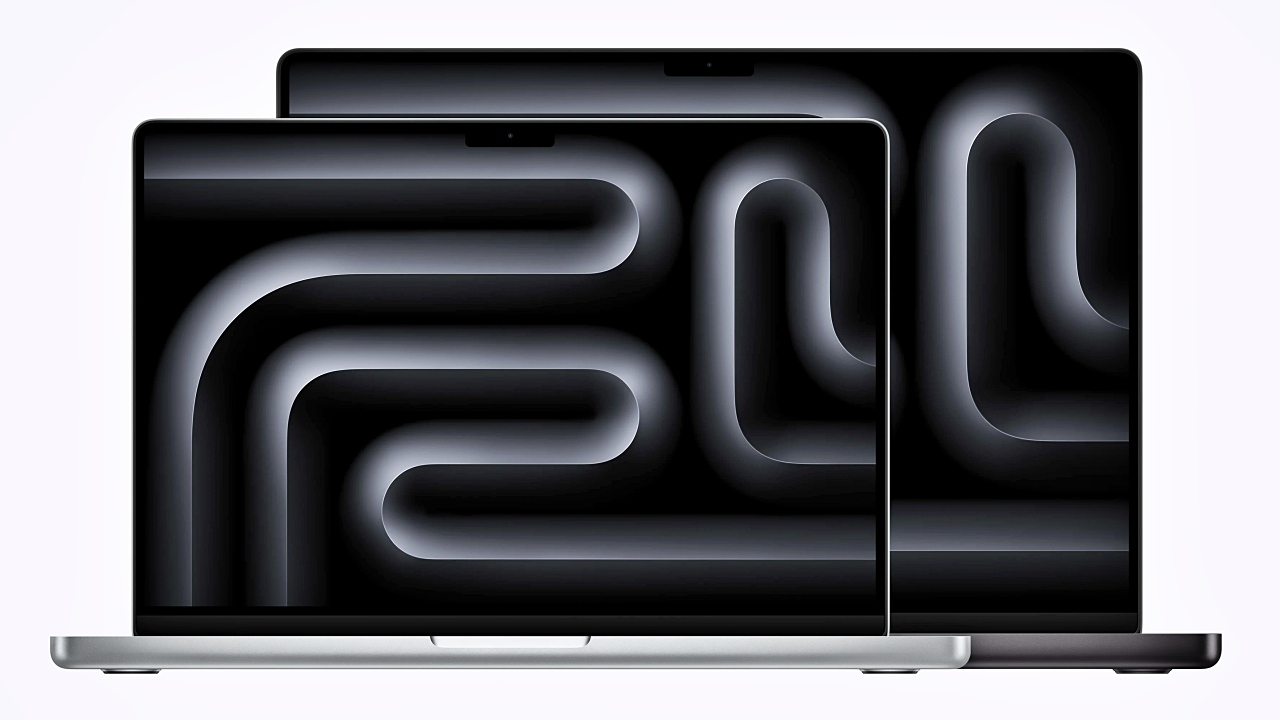
[DigitalToday reporter Jinju Hong] Apple is expected to introduce its first MacBook Pro OLED model with a touchscreen this week. It is expected to pursue a strategy of maintaining existing miniLED-based products while adding a new top-tier lineup, reshaping the range into three tiers and sharply raising prices for premium models.
According to IT outlet 9to5Mac on Oct. 25 (local time), Apple is likely to prepare a product line-up that runs from entry-level and mid-tier to top-tier models ahead of the new MacBook Pro launch. The new model is expected to feature an OLED display and a touchscreen. A lighter design and a new exterior design are also expected.
It has also been suggested the laptops could support Dynamic Island and cellular connectivity. If these changes materialise, the MacBook Pro would face its first major redesign since 2021.
A key part of the overhaul is the arrival of a top-tier model combining OLED and a touchscreen. Apple has so far maintained a strategy of not applying a touchscreen to the MacBook. If the new model is released, it could differentiate itself by adding touch controls to the existing trackpad- and keyboard-centred experience.
Portability and connectivity are also expected to improve, in addition to the display. With talk of a lighter design, Dynamic Island and possible cellular support, speculation has emerged that it will target premium users who value screen experience and mobility. Still, detailed specifications of those features need to be confirmed through an official announcement.
An entry-level 14-inch MacBook Pro is expected to be positioned at the bottom of the range. This model is expected to keep the existing design, use the next-generation M6 chip and adopt a configuration with lower heat dissipation performance than higher-end models. The price most widely cited is $1,999, the same as the current M5-based 14-inch model.
Memory could be offered at 16 GB as standard and storage at 1 TB, but there is also a forecast that storage could be set at 512 GB. As a result, the actual base specifications and price remain subject to change until the announcement.
In the mid-tier, the 14-inch and 16-inch MacBook Pro models currently on sale are expected to remain. The existing models with M5 Pro and M5 Max chips are likely to be sold with their design and key specifications unchanged, and with no major change in price.
This is seen as a strategy not to discontinue the existing premium models immediately while adding the new OLED touch model. It would broaden consumer choices by running the expensive top-tier model alongside existing models that are relatively more accessible.
The display supply structure also supports the possibility of parallel sales of existing models. Production of miniLED panels used in the MacBook Pro is expected to continue through 2028. As a result, even if an OLED model is added, miniLED-based products could remain in the lineup for the time being.
Expected prices vary by model. Based on 9to5Mac's forecast, a 14-inch M6 MacBook Pro is cited at $1,999, the current 14-inch M5 Pro model at $2,499, and the 16-inch M5 Max model at around $2,999.
The new OLED touch model is expected to be priced higher. The 14-inch model could start at $2,999 and the 16-inch model at $3,499, the report suggested. These are forecasts, not confirmed prices.
Bloomberg's Mark Gurman has also previously mentioned that the price of a redesigned MacBook Pro would rise significantly from existing levels. That implies a premium could be added to the price as OLED, a touchscreen and a new design are applied.
In that case, existing M5 Pro and M5 Max models could take on the role of easing the price burden between expensive new products and entry-level products. That is why analysis suggests Apple could raise the price of the top-tier model while keeping existing products to target demand across price points at the same time.
A range of price points is also being discussed across the broader MacBook lineup. The article cited prices such as $699 for a MacBook Neo, $1,299 for a 13-inch MacBook Air and $1,499 for a 15-inch MacBook Air. Still, the focus of this change is an expansion of the upper MacBook Pro lineup.
Key points to watch are how much the touchscreen actually changes the user experience and at what level the OLED model's price is set. If Apple presents touch as a new core differentiator, the MacBook Pro could expand from a performance-focused product into a lineup differentiated by display, control method and portability as well.
Price will also be a factor that divides market reaction. If the OLED touch model is launched at a high price as expected, existing miniLED models will remain a relatively reasonable option. The overhaul is expected to be an opportunity to reset the MacBook Pro's product tiers and pricing structure beyond merely adding a new model.
 Jinju Hong
hongjj@d-today.co.kr