
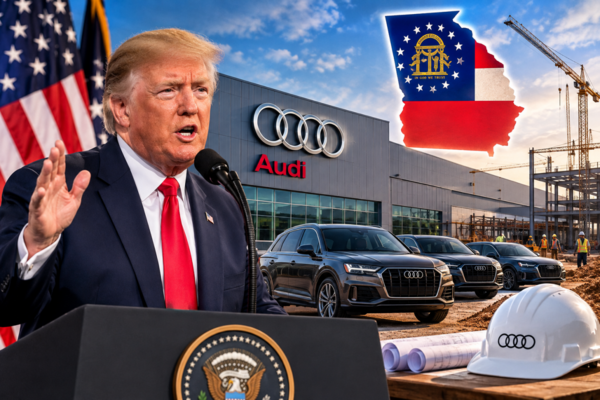
Audi will invest about $4 billion in the U.S. state of Georgia to build a sports utility vehicle (SUV) production plant. It set goals of producing up to 200,000 vehicles a year and creating about 4,500 jobs. With U.S. President Donald Trump highlighting the investment as a result of his tariff policy, attention is focused on whether expanding Audi's local production will become a breakthrough to cut import costs and respond to weak sales.
On Oct. 25, local time, blockchain media outlet Cryptopolitan reported that Trump disclosed Audi's plan at a Republican campaign event to build a plant near Macon, Georgia. Ahead of the Nov. 3 midterm elections, he cast attracting manufacturing investment in the United States as an outcome of his tariff policy.
The plant was presented as a project for Audi to step up core vehicle production in the United States. Audi, a Volkswagen brand, currently imports vehicles sold in the United States from overseas production bases such as Europe and Mexico. The new plant is expected to produce large SUVs including the Q7, Q8 and Q9.
Construction is scheduled for 2027, and the first vehicle production is planned for the early 2030s. Audi expects the investment to support about 4,500 jobs. Audi Chief Executive Gernot Doellner (게르노트 될너) said at the campaign event that it plans to produce large SUVs with premium specifications at the Macon plant, stressing long-term confidence in the U.S. market.
Audi's decision also reflects calculations to reduce tariff burdens. Audi last year took on cost burdens of about 1.2 billion euros, or $1.4 billion, due to U.S. tariff policy. Costs rose to import overseas-produced vehicles into the United States as the scope of tariffs expanded beyond finished cars to include steel, aluminum and auto parts.
Expanding local production in the United States could reduce part of the burden from import tariffs. With the Trump administration having pressed automakers to increase the share of production in the United States, the plant plan also aligns with its strategy to attract manufacturing.
Some counterarguments say tariff policy encourages investment by the auto industry while also increasing costs and uncertainty. Tariffs can lead to higher vehicle prices, and companies must also consider the possibility that trade rules could change. With large sums required to build local plants, investment burdens could grow if production and sales fall short of expectations.
Audi is also pushing to expand its production base in the United States beyond Georgia. In Blythewood, South Carolina, it plans to use a $2 billion plant owned by Volkswagen unit Scout Motors to pursue production of about 25,000 vehicles a year. It is also reviewing a plan to produce some vehicles that had been made in Europe in the United States and then export them to other markets.
The investment is also related to Audi's weak performance. Audi's global sales fell for a second straight year, and deliveries in the first half of 2026 dropped 7 percent from a year earlier. U.S. sales fell 16 percent this year, and weakness has continued in the China market. Volkswagen Group is also reviewing the possibility of closing or selling some plants in Germany as competition intensifies in Europe with Chinese companies such as BYD and Geely.
In this situation, the United States is emerging as a key market where Audi can reorganise its production bases. High trade barriers in the U.S. market, including tariffs of more than 100 percent on Chinese-made vehicles, increase the strategic value of local production. But building new plants does not immediately lead to improved profitability. If car demand falls short of expectations or plant utilisation remains low, the burden of fixed costs could grow.
Other global automakers are also considering or pushing to expand production in the United States. Toyota announced in July that it would invest $3.6 billion in its San Antonio plant site to build a large truck assembly line. It also laid out a plan to move part of its Mexico production to the United States and hire 2,000 people by 2030. Honda is reviewing an additional plant on the condition of an extension of the U.S.-Mexico-Canada Agreement, and Hyundai Motor has said more than $20 billion in investment in the United States would be possible once trade rules become clear.
On the other hand, the Trump administration's reduction of electric vehicle incentives is weighing on expanding electric vehicle and battery production in the United States. With employment in automobile and parts manufacturing also shown to have declined, whether using tariffs to attract manufacturing can translate into actual investment and job growth remains a challenge.
Audi's Georgia plant plan shows a trend in which global automakers reorganise manufacturing bases by considering tariffs, market demand and production costs. The outlook is that key variables that will determine the real results of large-scale investments will be the durability of tariff policy, U.S. SUV demand and plant utilisation rates.
 Jinju Hong
hongjj@d-today.co.kr