
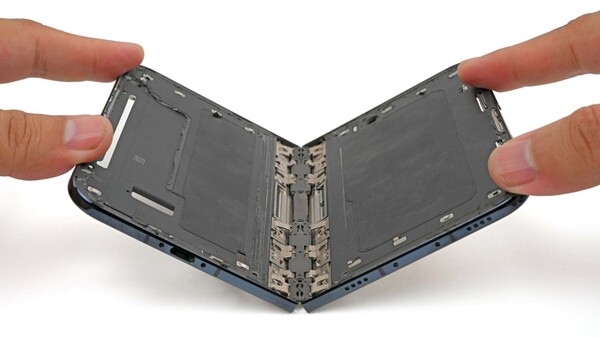
Early display failures reported in Apple’s first foldable phone, the iPhone Duo, may be linked to the hinge’s internal structure.
On Oct. 25 (local time), foreign media including IT outlet NineToFiveMac reported that repair specialist iFixit said its teardown and analysis of the iPhone Duo suggest there may be a connection between the areas where screen damage was reported and the hinge’s internal structure.
iFixit gave the iPhone Duo a repairability score of 5 out of 10. It is the highest score among foldable smartphones. The assessment is preliminary and does not reflect whether replacement parts are supplied.
The hinge was central to the teardown. The iPhone Duo uses a complex structure combining gears, springs and metal joints. It also includes a waterdrop-style design that creates space to prevent the display from bending excessively, and a curved guide intended to reduce strain on the screen when opening and closing the device.
Some users, however, reported that a sound occurs when folding or unfolding the device and a bright line then appears on the inner screen. Many cases of damage are said to have occurred near where the cable passage connecting the two halves meets the central hinge support.
iFixit built a 3D model of the hinge and analysed possible causes based on CT scans, teardown video and Apple patents. It proposed a hypothesis that excessive pressure could be applied to the screen if the central support does not retract properly when the device is closed. It also cited as a potential cause that the curved rail that guides hinge movement rises higher than surrounding parts during folding. It said the rail could interfere with the screen if it does not move normally.
It also raised the possibility that stress could concentrate on the thin display layer because the damaged area brings together the edges of several structures and components. iFixit said it could not confirm the direct cause of the screen failures from this analysis alone. It presented the similarity between damage patterns reported by some users and the hinge’s internal structure as a lead for further investigation.
The display design also showed technology intended to make the crease less noticeable. The matte nano-texture surface on the inner screen disperses light reflection to hide folding marks. Microscopic analysis also observed oval subpixels arranged in different directions. iFixit explained, citing Apple patents, that this arrangement could help reduce visual artifacts caused by diffraction.
Above the internal selfie camera, a pattern is applied that widens spacing between pixels to allow light to reach the camera. The bezel at the edge of the inner screen could be removed without breakage by using clips instead of adhesive, and the outer screen was also relatively easy to remove.
The battery consists of 2 cells. One sits under the rear glass and the other under the outer screen, meaning both sides of the device must be opened to replace both batteries. The capacities are 11.567Wh and 7.506Wh, for a combined 19.073Wh. The 2 batteries use electrically releasable adhesive. iFixit rated this as the best battery removal method it has experienced in foldable smartphones.
The iPhone Duo has relatively high repairability for a foldable phone, but long-term reliability of key parts, including the inner screen and hinge, remains to be verified. With early failures concentrated in the same area, the next point of interest is what stability Apple’s hinge design will show in real-world use.
 Seung-a Yoo
ysah@d-today.co.kr