
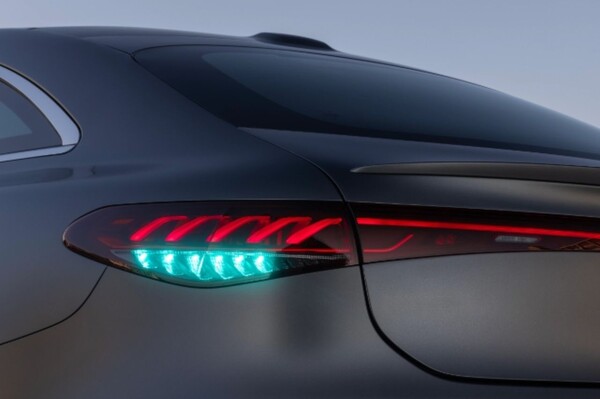
The U.S. National Highway Traffic Safety Administration (NHTSA) is pushing a plan to use teal lights to indicate an autonomous vehicle's operating status. It plans to set standards for exterior vehicle lighting in preparation for wider use of self-driving cars and to partly revise existing vehicle safety regulations.
On Oct. 24, local time, NHTSA released a draft that includes identification lighting for autonomous vehicles and proposed amendments to the Federal Motor Vehicle Safety Standards (FMVSS), according to EV-focused outlet Electrek and others.
The key element is teal exterior lighting that turns on only in self-driving mode. The aim is to help police or rescue personnel immediately recognise that a vehicle is operating autonomously when they encounter a vehicle with no one in the driver’s seat. There is currently no standardised system in the United States to indicate a vehicle’s autonomous-driving status.
The draft stipulates that the lights must be on only while the vehicle is operating autonomously and must be off when a person is driving. All indicator lights must turn on and off simultaneously, and they must be visible from the front, both sides and the rear. The proposed installation height is at least 15 inches above the ground. The lighting, however, would be optional rather than mandatory.
The plan is based on a system first proposed by Mercedes-Benz. Mercedes-Benz proposed installing teal exterior lighting alongside its Level 3 driver-assistance system, Drive Pilot. The system is designed to allow the driver to hand driving responsibility to the vehicle under certain conditions. Mercedes-Benz tested the lighting system in California for 2 years, and NHTSA is reviewing a plan to expand it into a nationwide standard reflecting opinions from the Society of Automotive Engineers (SAE).
China also announced a similar draft standard. China proposed using a turquoise shade in the teal family for autonomous-vehicle indicator lights, aiming for implementation in 2028. The goal is to reduce situations where different autonomous vehicles use different lights and to have automakers follow a unified indicator system.
The U.S. draft includes proposed safety-rule revisions reflecting design characteristics of autonomous vehicles in addition to lighting standards. Current rules require turn signals to switch off automatically when a steering wheel turned beyond a certain angle returns to a neutral position, but that is difficult to apply to autonomous vehicles without steering wheels, so the draft includes a plan to delete that requirement. Headlight-related rules will also be partly adjusted to increase flexibility in vehicle design.
The revisions are intended to reflect in current safety standards autonomous vehicles with structures different from existing vehicles, such as Tesla’s Cybercab or Zoox’s robotaxi. There is also criticism that care is needed so that regulatory easing tailored to autonomous vehicles does not weaken safety standards.
NHTSA plans to soon begin gathering public comments on the draft. The comment period will be 30 days.
 Seung-ah Yoo
ysah@d-today.co.kr