
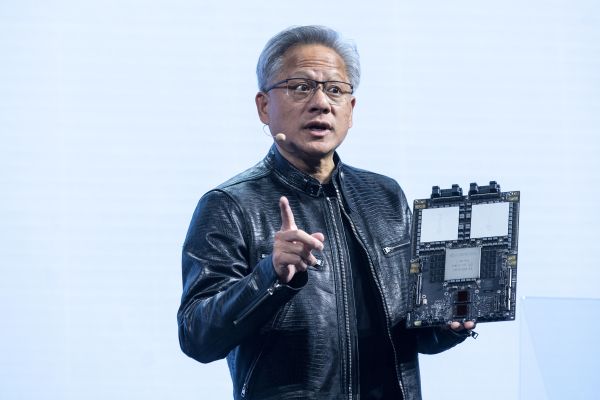
[Digital Today Seung-a Yoo, intern reporter] Nvidia Chief Executive Jensen Huang cited decades of cooperation with foreign companies, government industrial policy and accumulated manufacturing technology as factors behind Taiwan's semiconductor industry's global competitiveness.
On Oct. 24, TechRadar reported that Huang, speaking in a recent conversation with well-known podcaster Lex Fridman, said cooperation with European companies helped build the technical foundation of Taiwan's electronics industry. Taiwan now produces more than 90 percent of the world's most advanced semiconductors and holds a key position in the global technology supply chain.
The process dates back to the 1950s. At the time, Taiwanese economic planner Li Kwoh-ting promoted cooperation with foreign companies to develop domestic manufacturing technology. Taiwan brought in Dutch electronics company Philips, and Philips' participation became an opportunity to introduce industrial knowledge and production technology into Taiwan's electronics industry.
Taiwan Semiconductor Manufacturing Co (TSMC) later grew into a key company for advanced contract chip manufacturing, while Dutch equipment maker ASML became a leading company in lithography tools needed for chip production. The two companies differ in business areas and development paths, but early international industrial cooperation, including with Philips, is cited as one factor behind the formation of Taiwan's technological base. Still, today's semiconductor industry was not formed solely through cooperation with a single company.
Growth in Taiwan's electronics industry also aligned with the expansion of the personal computer market. As IBM disclosed PC architecture specifications, other manufacturers were able to make compatible products, boosting demand for related components and chipsets. Taiwanese companies seized growth opportunities by designing chipsets and supplying computer parts. TSMC and United Microelectronics Corp (UMC) later became major chipmakers through different strategies and development paths.
When Michael Dell started his computer business, Taiwanese suppliers also took part as part of the international components supply chain. Dell's success, however, was driven not only by parts procurement but also by direct sales and business operations, and IBM's influence was also a separate stage of industrial development from Philips' early cooperation.
Huang's explanation shows Taiwan's chip competitiveness was formed through cooperation with foreign companies, responses to market change, and sustained investment and technological development. Taiwan now produces more than 90 percent of the world's most advanced semiconductors. As the spread of artificial intelligence boosts demand for high-performance processors, Taiwan's capacity to produce advanced chips is becoming more important. As governments and technology companies move to secure stable chip supply chains, there is also an assessment that it is difficult for other regions to replicate in a short period the manufacturing expertise Taiwan has accumulated.
 Seung-a Yoo
ysah@d-today.co.kr