
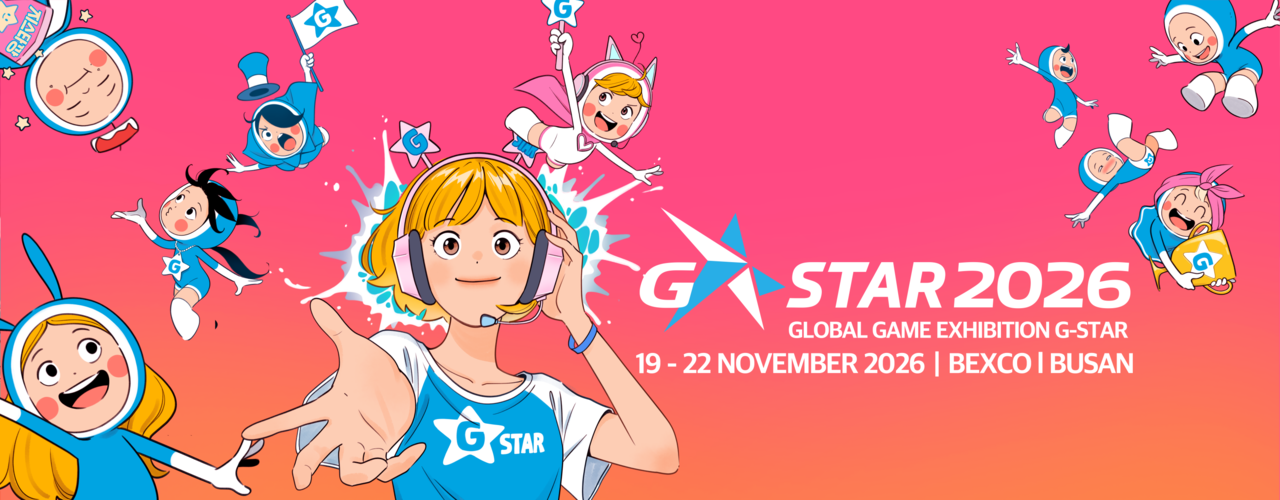
G-Star and AGF, seen as leading game events in South Korea, are seeking change through different strategies. While G-Star is widening its exhibition scope to include AI and overseas game companies, AGF is strengthening its fan marketing function around major game companies’ new titles and existing intellectual property.
This year, G-Star will be held at BEXCO in Busan from Nov. 19 to 22, and AGF at KINTEX in Goyang, Gyeonggi Province, from Dec. 4 to 6. In a notable shift, NCSoft, last year’s main sponsor of G-Star, will serve as AGF’s main sponsor this year.
Big game publishers absent; G-Star diversifies its participant base
Instead, this year’s main sponsor of G-Star is WRTN Technologies, which operates the AI character chat service "Crack". It is the first time since the event launched in 2005 that a company that is not a game publisher has served as main sponsor.
In the list of major exhibitors for the general public (BTC) disclosed so far, Nexon, Netmarble and NCSoft are not included.
Game exhibitions are affected by major publishers’ new title development schedules. Large-scale exhibitions are possible when the timing fits for unveiling anticipated titles, but if development timelines do not align it becomes difficult to secure core content. Cho Young-gi (조영기), chairman of the G-Star Organising Committee, also explained at an August press briefing that there are not many new titles that large game companies will showcase.
The organising committee is therefore pushing to "expand the boundaries of the industry and the audience base". It broadened touchpoints with non-game content by bringing in an AI service as main sponsor and creating the event’s representative image with Lee Dong-gun (이동건), the creator of the webtoon "Yumi's Cells".
In games, it is strengthening participation by overseas developers and indie games. With Capcom joining on the 20th, the second exhibition hall completed a lineup of 5 global game companies: Sega, Koei Tecmo, NetEase Games, CD Projekt Red and Capcom. Capcom will run first hands-on demos in South Korea for titles including "Rockman: Dual Override" and "Monster Hunter Wilds Ascendance" at about 35 booths.
In South Korea, Krafton will exhibit 5 titles including "PUBG", "Tara: Unbound" and "Age Twister". Webzen and HoYoverse will also take part, and 106 developers from South Korea and abroad will participate in the indie game exhibition across 250 booths.
G-Star’s expansion is interpreted as a strategy to ease a structure in which the event’s competitiveness is shaped by whether large game companies unveil new titles. Broadening the participant base to overseas game companies, indie developers and content companies could reduce the impact of domestic publishers’ development schedules. Still, whether the expanded scope translates into visitor satisfaction and tangible business results remains a task.
AGF gathers new and existing titles, strengthens fan marketing
As G-Star diversifies its participant base, the presence of game companies is growing at AGF. Following 2024’s "Myeongjo: Wuthering Waves" and last year’s Smilegate, game-related main sponsors have participated for 3 consecutive years, with NCSoft joining this year.
This year’s disclosed participant list includes upcoming releases such as "Azur Promilia", "Paraydollia", "Silver Palace" and "Persona 4 Revival". It also foreshadowed displays of existing works’ IP including "Brown Dust 2", "Metaphor: ReFantazio" and "Cats & Soup". Smilegate and Yostar will also participate.
In particular, NCSoft is focusing on a single title, "Astrae Oratio", under development by Dynamis One. Unlike last year’s G-Star, where it unveiled 5 new titles across about 300 booths, it will set up 150 booths at this year’s AGF to offer game demos and limited-edition goods. Nexon plans to exhibit "Azur Promilia" and "Paraydollia", while Smilegate plans to showcase "Miraesi: The Invisible Future" and "Chaos Zero Nightmare".
Companies targeting subculture fandoms are also taking part beyond game publishers. SOOP will serve as an official sponsor of AGF for the first time this year and present virtual streamer content related to games and animation. It plans to introduce online-focused virtual content offline and expand opportunities to communicate with fans. Game distribution platforms such as Google Play and Galaxy Store will also participate.
AGF drew 100,518 visitors last year, up about 40 percent from the previous year, and exhibition booths rose about 26 percent to 1,075. However, the event period was extended from 2 days to 3, and the total number of participating companies fell to 71 from 75. That is why it is difficult to judge that the number of participating companies or the overall fandom expanded solely based on the increase in visitors and booths.
AGF’s competitiveness is analysed as lying more in user characteristics than simple visitor scale. Users with strong interest in animation, characters and subculture games gather there, making it advantageous for promoting new titles and managing fandoms for existing games.
Hana Securities analyst Jun-ho Lee (이준호) also assessed in a December report titled "AGF 2025: Fandom is the Future" that existing released titles such as "Goddess of Victory: NIKKE", "Brown Dust 2" and "Mabinogi Mobile" stood out for attempts to manage fandoms and extend games’ lifespans through goods and experiential booths.
In this way, AGF has a characteristic that it can continue meeting fans by using characters and worldviews from existing games even without new titles. Unlike G-Star, where new-title disclosure schedules are an important variable in exhibition composition, fandoms of released games themselves can be used as exhibition content. For game companies, especially those for whom long-term service is important, it can be an opportunity to maintain existing users’ interest while widening touchpoints with new users.
Purpose over scale as competition benchmarks for game events change
Changes at the two events show that game companies’ exhibition strategies are becoming more segmented depending on a title’s nature and target user base. A comprehensive exhibition may suit cases where companies unveil new titles across genres or look for overseas business opportunities, while specialised events may be suitable when they want to publicise new titles to users of a specific genre or maintain existing fandoms.
Still, the two events are not in a substitute relationship. G-Star also runs experience programmes using existing popular titles, and AGF likewise covers various areas including not only games but also animation and virtual content. With NCSoft having participated in both events last year, it is closer to a case of varying participation methods to fit each event’s purpose.
Ultimately, G-Star needs to link its expanded participant base to visitor satisfaction and business opportunities, and AGF needs to translate subculture fandom interest into new-title success and long-term user engagement. Whether their different strategies can produce real results is expected to determine future competitiveness.
An industry official said, "Game events that used to centre on new title reveals are expanding their roles to include managing existing IP and communicating with users, and game companies’ participation strategies are changing as well." The official said, "G-Star’s task going forward is to prove results from diversifying content, while AGF needs to demonstrate the effectiveness of fandom-centred marketing."
 Ho-jung Lee
lhj@d-today.co.kr