
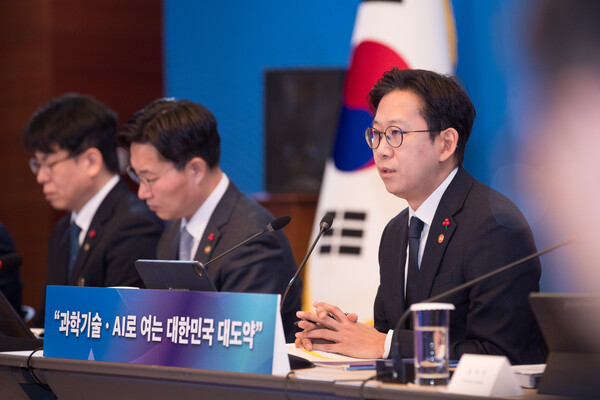
The government disclosed in real time to the public its process of pursuing a major national transformation based on science and technology and AI.
The Ministry of Science and ICT held briefings from a total of 55 agencies, including the Korea AeroSpace Administration, affiliated and public institutions, and related bodies, over three days from Jan. 12 to 14, chaired by Deputy Prime Minister and Minister Bae Kyung-hoon. The ministry live-streamed the briefings on its YouTube channel or KTV. It strengthened communication by discussing public comments submitted online in real time and having relevant agencies respond.
◆NST to open 'National Science AI Institute' in June
On Jan. 12, a total of 28 organisations reported, including the National Science and Technology Council (NST), government-funded research institutes in science and technology and public institutions. The briefings focused on AI-based innovation in science and technology, resetting each institution’s unique mission and strengthening industry-academia-research collaboration, in line with an AI transformation and a project-based system (PBS) direction.
NST will move to establish a National Science AI Institute. It will begin setting it up this month and open it in June after completing the building, AI infrastructure and operating system. The institute will serve as a hub supporting AI-based innovation in science and technology, centred on government-funded research institutes.
The National AI Research Institute’s budget for this year is about 40 billion won. It will first run an 'AI research colleague' as a pilot for government-funded research institutes. The AI colleague research is a new collaboration model in which AI participates in the entire research process, including experiment design, data analysis and interpretation of results, as a research partner for scientists.
With PBS abolished this year, government-funded research institutes will operate 'strategic research groups' focused on strategic technology R&D. NST plans to set up a dedicated organisation in February to support strategic research projects across their full life cycle and to run an industry-research-government consultative body for research planning.
The evaluation system for government-funded research institutes will also change. It will integrate the existing three-year management evaluation and six-year research evaluation. A one-year integrated evaluation system that assesses research and management together will be applied. From July, performance bonuses will be paid based on integrated evaluation results, and a system to pay bonuses to outstanding researchers will be introduced.
In a briefing by R&D planning and management agencies, the ministry urged thorough preparations to ensure the largest-ever R&D budget is properly executed. It will introduce to South Korea a national strategy similar to the U.S. Trump administration’s 'Genesis Mission' and redesign the overall research structure, administration and infrastructure around AI.
Bae emphasised that government-funded research institutes should set goals that can create synergy with universities and companies from the perspective of the overall institutional ecosystem to produce global results. He also stressed the need to upgrade scattered data into high-quality data that can be used for learning.
◆ Postmen to check empty homes as postal role expands
On Jan. 13, a total of 12 agencies, including the National Science Museum and the Korea Post, announced their work plans. Bae urged the building of an information-sharing platform centred on the National Science Museum. He also asked science museums to take an active role in areas such as AI education to improve AI literacy for the whole population.
In the postal sector, agencies reviewed presidential directives discussed at a briefing in December last year, including finding outsourced public services related to welfare and administration and drug testing.
Korea Post plans to pilot an empty-home survey in which postmen check whether homes are vacant and share information with the Korea Real Estate Board. It will build a logistics centre in the greater Seoul area for faster delivery and expand next-day delivery. It also plans to develop a warehousing agency business for small and medium-sized shippers.
It will also partner with the convenience store industry to increase mail acceptance space, while expanding the number of 'eco mailboxes' that can take returned items such as discarded medicines and used coffee capsules to 1,000.
As residents in areas without bank branches will be able to use face-to-face banking services at post offices and other locations from this year under rules allowing banking agency operations, it will develop policy and retail financial products and pursue fintech partnerships and diversification of protection-type insurance.
Korea Post plans to push ahead quickly with AX, including embedding AI in logistics work and demonstrating AI unmanned post offices. It will strengthen information security, including automatic data encryption, and work to advance its disaster recovery system to prevent a recurrence of the disruption to the post office shopping service caused by a fire at the National Information Resources Service.
Bae asked Korea Post to strengthen measures to improve postal operating losses. He also called for steps to prevent financial fraud targeting vulnerable groups in its financial business.
◆ National AI Computing Center push accelerates; special judicial police for cyber intrusions introduced
On Jan. 14, briefings were held by the Korea AeroSpace Administration and space-sector research institutes, the four major science and technology institutes, and affiliated and public institutions in the AI and ICT sectors.
Bae first praised the efforts of researchers and participating companies after the successful fourth launch of the Nuri rocket. On science and technology institutes, he asked for cooperation with companies, research institutes and universities centred on areas of regional strength to turn them into footholds for regional growth, and stressed their role in deep-tech start-ups.
The National IT Industry Promotion Agency (NIPA) will move to expand AI infrastructure this year, aiming to secure 15,000 advanced GPUs. Along with the AI infrastructure expansion, it will complete an implementation agreement for the National AI Computing Center and establish a special purpose company (SPC) in the first half of the year. It will also begin support from February for the use of advanced GPUs secured through a supplementary budget last year.
Bae also mentioned the need for more advanced information security. The Korea Internet & Security Agency (KISA) will complete the introduction of 'special judicial police' by the first half of this year. At present, a hacking investigation can be conducted only after a company acknowledges an incident and files a report itself. If special judicial police are introduced, forced investigations can be carried out.
A ministry official said it is holding consultations with the Ministry of Justice on introducing special judicial police. The official added that it also plans to prepare a manual on the level of special judicial police investigations.
The ministry will bring together the full capabilities of the ministry and related agencies for a 'major national leap forward opened by science and technology and AI'. It plans to turn follow-up measures derived from the briefings into tasks and have Bae personally check progress on implementation.
 Jin-ho Lee
jhlee26@d-today.co.kr
Jin-ho Lee
jhlee26@d-today.co.kr