
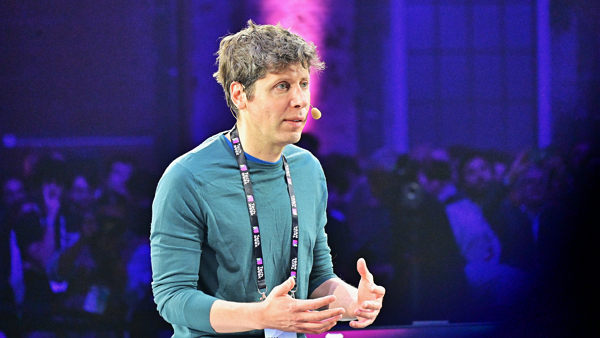
OpenAI CEO Sam Altman (샘 알트먼) presented three scenarios for how competition in advanced artificial intelligence could end: постоян supervision by an international monitoring body, integration among leading companies, or overwhelming dominance by a specific company.
Cryptopolitan, a blockchain media outlet, reported on Oct. 20 that Altman said the AI race is likely to converge on one of these three structures.
The Information reported that he cited scenarios in which one company neutralises a rival's hardware and pushes other players out of the market, or leading companies merge and are reorganised into a single entity. He also presented a structure in which multiple players coexist under the supervision of an international watchdog.
A path for multiple companies to keep competing is for an external watchdog to supervise the industry. He offered a similar idea in OpenAI's 2023 "Superintelligence Governance". At the time, OpenAI argued there was a need for an organisation similar to the International Atomic Energy Agency that could demand inspections and audits of the most powerful AI systems and verification of compliance with safety requirements.
OpenAI is currently working with Google and Anthropic to establish a "Frontier AI Standards Body". It is known to be structured closer to the U.S. securities industry's self-regulatory body FINRA than to a model under government supervision. That differs from the IAEA-style model Altman previously presented.
Altman said at the U.N. Security Council in September that OpenAI could slow its pace of development and called for national and international standards. U.S. President Donald Trump also unveiled a voluntary agreement in late September for self-governance by major AI labs.
Discussions about adjusting the industry's development pace led to an antitrust lawsuit. Four paid subscribers to AI services filed a lawsuit in U.S. federal court in September, claiming OpenAI, Anthropic, SpaceXAI and Google illegally agreed to slow AI development.
Against this backdrop, OpenAI has moved to raise large-scale funding to expand its business. Reuters reported the company is nearing the completion of an investment round of about $30 billion, and that its valuation could be discussed as exceeding $1.4 trillion. It was reported that a main aim is to finalise the valuation ahead of Anthropic's mid-November initial public offering.
Competition to attract investment is also intense. OpenAI and Anthropic are raising funds from the same sovereign wealth funds and institutional investors. OpenAI told investors that annualised revenue reached $50 billion after the launch of GPT-6 Astra and could rise to $70 billion by year-end.
OpenAI supports a federal-level regulatory framework to establish consistent safety requirements, but says the industry does not need to wait for antitrust exemptions or legislation to take action. With discussions continuing over external oversight and industry self-regulation while competition for funding intensifies, attention is turning to which of the three scenarios Altman outlined will materialise.
 Yoonseo Lee
yslee@d-today.co.kr