
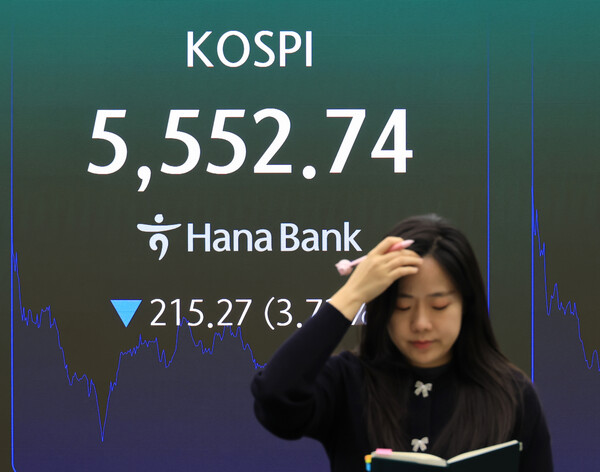
As volatility in South Korea's stock market increases, sidelined cash that could flow into equities and so-called debt-funded investing are both shrinking.
The Korea Financial Investment Association said investor deposits stood at 90.2975 trillion won as of Oct. 20, down 1.7990 trillion won from the previous trading day.
Investor deposits are funds in securities accounts that have not yet been used to buy stocks or other financial products. They are used as an indicator of cash waiting to enter the stock market.
Deposits have fallen for 6 consecutive sessions. They are at their lowest level since hitting 89.3099 trillion won on Jan. 14.
Margin lending, in which investors borrow from brokerages to buy stocks in anticipation of share gains, is also declining. Margin loan balances stood at 30.5138 trillion won on Oct. 20, down 594.3 billion won from the previous session. That is the lowest level since 30.4187 trillion won on Aug. 12.
Investor deposits and margin lending typically rise together when expectations for a stock market rally increase. The recent simultaneous decline in both indicators is seen as reflecting lower risk appetite among investors after sharp share price swings.
The KOSPI closed at 5,552.74 on Oct. 20, down 3.73 percent from the previous session. As the index has been swinging sharply even within a single day, the outflow of short-term investment funds from the market is also becoming more apparent.
Along with the decline in margin trading, the scale of forced selling has also eased. Forced selling totaled 22.6 billion won on Oct. 20, down to less than half of 54.2 billion won the previous day.
Forced selling refers to brokerages liquidating stocks held as collateral when investors fail to repay borrowed funds or unsettled balances on time. Earlier, forced selling had exceeded 50 billion won a day for 5 straight sessions.
The share of forced selling relative to unsettled balances also fell to 1.6 percent from 4.4 percent the previous session.
As the stock market is repeating sharp drops and rebounds over a short period, whether investor deposits rise again and sidelined cash flows back into equities, and whether the decline in margin lending continues, are expected to be key indicators of retail investor sentiment.
 Oh Sang-yup
yub@d-today.co.kr