
AI cloud company Elice Group plunged on its first day of trading after listing on the KOSDAQ and rebounded to the daily limit the next day.
While large-scale borrowing and the burden of capital spending are drawing attention in the global AI infrastructure industry, Elice says it is maintaining a high operating profit margin with a conservative investment strategy of building infrastructure after confirming customer demand.
The Korea Exchange said on Tuesday Elice Group ended the session up 29.92 percent at 79,900 won. It closed at 61,500 won on its first day on the KOSDAQ on Monday, down 32.0 percent from its IPO price of 90,500 won, before rebounding to the daily limit a day later. Still, the closing price on Tuesday was about 11.7 percent below the IPO price.
Immediately after listing, shares available for trading accounted for about 16 percent of the total, which may have increased volatility due to the limited free float. Separately from the share-price moves, Elice's profit structure and investment approach differ from those of global AI cloud companies.
On a consolidated basis, Elice Group posted first-half revenue of 34.4 billion won and operating profit of 10.3 billion won. Its operating profit margin was 30.1 percent, sharply up from 13.1 percent for the full year last year. Earnings before interest, taxes, depreciation and amortisation (EBITDA) was also 23.2 billion won, or about 67.5 percent of revenue.
The performance improvement was led by the AI cloud business. First-half AI cloud revenue was 26.2 billion won, accounting for 76.2 percent of total revenue. The result reflects Elice, which originally grew through an AI education business, rapidly shifting its business structure to focus on operating graphics processing unit (GPU) infrastructure.
In the global market, concern has recently been growing over risks surrounding neocloud companies such as CoreWeave.
CoreWeave has aggressively expanded AI data centres based on Nvidia GPUs.
The issue is the scale of investment and financing costs. Reuters, citing LSEG data, reported CoreWeave's borrowing debt was estimated at about $50 billion. Second-quarter revenue reached $2.575 billion, but it posted an operating loss of $49 million and a net loss of $626 million. Net interest expense alone was $640 million in the same period.
Despite securing long-term contracts with major customers, the financial burden has grown as the gap between large-scale capital spending and recovering investment has lengthened. If demand for AI computing slows more than expected or funding costs rise, that could lead to concerns about worsening profitability.
Elice, by contrast, says it is pursuing a strategy of deciding the scale of infrastructure investment after first weighing customer demand and financing costs. It says it minimises risk by building facilities when demand is confirmed and not proceeding with investment when it is not.
Elice Group CEO Jaewon Kim (김재원) said at an IPO press briefing on Sept. 30, referring to concerns about a bubble in AI investment, "There are naturally worrisome parts about the current bubble talk."
He went on to describe the company's investment approach, saying it decides whether to build after comprehensively considering customer demand, financing costs and available supply, and added, "Without that, we don't go in, so our position is to reduce risk at least."
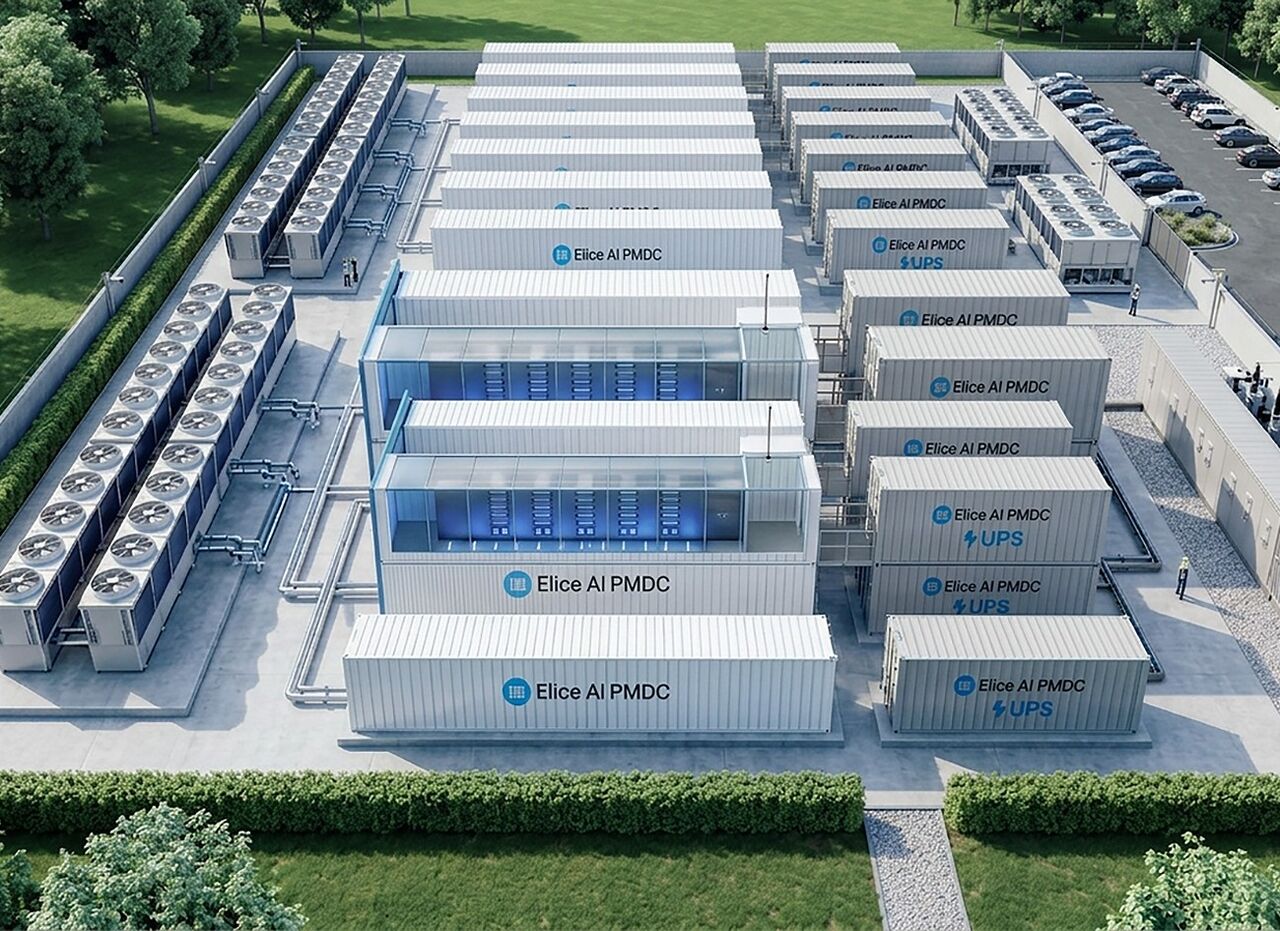
Elice's neocloud strategy is based on its self-designed modular AI data centre, or PMDC. It pre-manufactures key facilities such as servers and power, cooling and networking at a factory and installs them on site, allowing it to expand computing resources in stages depending on customer demand.
The company says PMDC shortens construction time to within three months and cuts initial build costs by up to 40 percent compared with conventional data centres. It said this enables a quick response to demand without pre-emptively securing large-scale facilities.
Elice's total equity at the end of the first half was 97.4 billion won and total liabilities were 66.8 billion won, for a debt ratio of 68.6 percent. Total borrowings including lease liabilities were about 47.2 billion won, and its interest coverage ratio was 23.6 times, with operating profit comfortably exceeding interest costs.
Sunyou Jin (선유진), an analyst at LS Securities, said in a report released on Sept. 29 that Elice's capabilities in building modular data centres and its in-house cloud operating software were key strengths. She particularly analysed that the operating leverage effect from infrastructure investment drove an EBITDA margin of about 68 percent in the first half of this year.
Elice is also not free from financial burden as it expands its business. Total borrowings rose from about 5.1 billion won at the end of 2024 to 29.8 billion won at the end of last year and 47.2 billion won at the end of the first half of this year.
 Seulgi Son
sageson@d-today.co.kr