
Tesla beat market expectations for vehicle deliveries in the third quarter of 2026, but revenue is expected to remain flat and profit to fall. Market attention is focused less on vehicle sales than on how well it can control worsening profitability and the burden of large-scale investment.
Electrek, an electric-vehicle media outlet, reported on Oct. 20 that Tesla will announce third-quarter results after the market close on Oct. 21. The Wall Street consensus is revenue of $28.06 billion and non-GAAP earnings per share (EPS) of $0.45. Revenue is similar to $28.10 billion a year earlier, but EPS is expected to fall 10 percent from $0.50. Estimates forecasts revenue of $28.36 billion and EPS of $0.48.
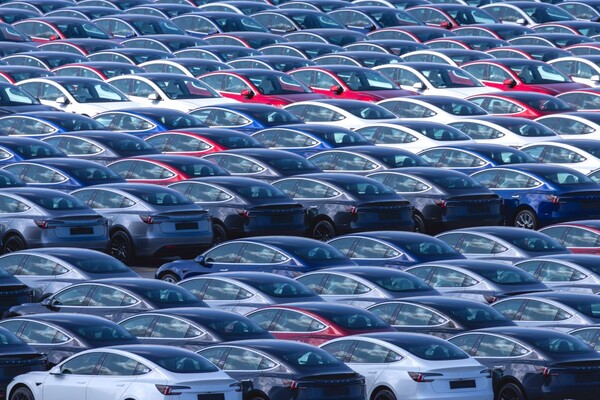
Tesla delivered 486,532 vehicles in the third quarter. That was down 2.1 percent from 497,099 a year earlier, but above the average estimate of 461,974 from 24 analysts. Production totaled 464,391 vehicles, below deliveries. It reduced inventory for a second consecutive quarter, but it is unclear whether higher deliveries will translate into improved results.
The concentration by model continued. Model 3 and Model Y accounted for 478,237 vehicles, the majority of total deliveries, while deliveries of other models such as Cybertruck, Semi, Model S and Model X fell 48 percent from a year earlier to 8,295. Energy storage deployments rose 9.6 percent from a year earlier to 13.7 gigawatt hours (GWh), but missed the market estimate of about 15.9 GWh.
Profitability is a key variable. Tesla's second-quarter operating margin fell to 1.4 percent, and operating profit dropped 57 percent from a year earlier to $398 million. Operating expenses, however, rose 47 percent to $4.35 billion. EPS also came in at $0.33, below the market estimate of $0.53.
In particular, automotive gross margin excluding regulatory credits fell to 16.3 percent in the second quarter from 19.2 percent in the first. Regulatory credit revenue also fell 67 percent from a year earlier to $146 million in the second quarter. Second-quarter free cash flow posted a deficit of $1.09 billion, and capital expenditures more than doubled to $5.8 billion. The company forecast full-year capital expenditures this year will exceed $25 billion.
In a conference call after the earnings release, key questions are expected to include expansion of the Cybercab, regulatory responses and the timing for introducing unsupervised Full Self-Driving (FSD) in customer vehicles. Shareholders are also focused on the production cost of the Optimus robot and plans to secure early customers.
Ultimately, the key to these results is whether strong deliveries lead to a recovery in profitability and whether it can curb rising costs while bearing large-scale investment in artificial intelligence (AI) and autonomous driving. If flat revenue and falling profit materialise, Tesla's slowdown in its core business growth and its investment burden could come into focus.
 Seungah Yoo
ysah@d-today.co.kr