
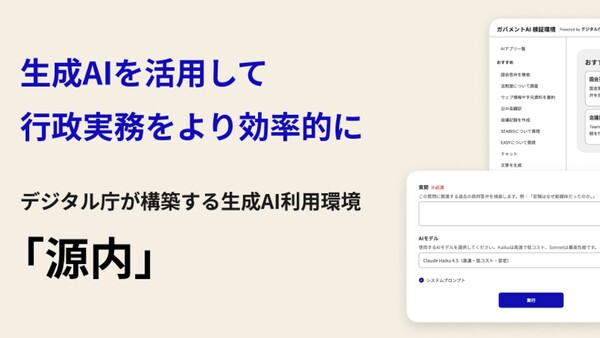
The Japanese government will expand an environment for using AI agents for about 180,000 civil servants. It aims to raise the efficiency of administrative work by supporting staff in creating AI agents themselves and using them for document drafting, research and program development.
On Oct. 20 (local time), Japanese media outlet ITmedia reported that Japan's Digital Agency announced it would introduce 2 types of AI agent functions into Gen-nai, a generative AI platform for government employees.
First, agent chat, which will be provided to ministries on a rolling basis starting on the day, lets users create and run AI agents through conversation alone. Staff can give instructions in natural language so the system can handle multiple tasks in sequence, such as web searches and drafting materials.
Gen-nai Workshop, which is targeted for introduction by December, supports more complex work. It is a development environment in which AI autonomously writes and modifies program code, manipulates files and even conducts tests.
The Digital Agency said that building a government-wide common foundation that allows about 180,000 civil servants, including general administrative staff, to use such advanced AI agents is a first in the world.
As AI takes on a broader range of tasks, it will also strengthen security and accountability management. The Digital Agency released Gen-nai governance, security and safety standards on the day. The standards, prepared with cooperation from the AI Safety Institute of Japan (AISI), include responsibilities and compliance requirements for users, administrators and developers.
Digital Minister Toshiharu Furukawa (후루카와 도시하루) explained that the standards could also serve as a reference for local governments and private companies considering adopting AI agents.
The Digital Agency plans to release Gen-nai OSS 2.0 around February 2027, allowing anyone to use, modify and redistribute the 2 functions.
Gen-nai began internal use at the Digital Agency in May last year, and since May this year it has been conducting large-scale trials involving about 180,000 employees across all ministries. The trials will continue through March 2027.
The Japanese government said the project is intended to help civil servants focus on policy judgments and high-value-added work rather than repetitive tasks.
 Jae-won Choi
ittt_0801@d-today.co.kr