
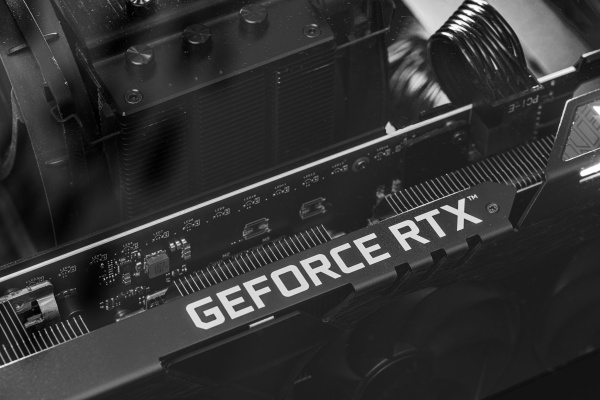
[DigitalToday reporter Jinju Hong] China’s ByteDance, Alibaba and Tencent have reportedly ordered more than 3 million units of Nvidia’s new workstation graphics card, the RTX PRO 5500. The total order value exceeds $35 billion at list prices.
Bloomberg reported on Oct. 20 local time that as U.S. semiconductor export controls to China block supplies of high-end AI chips, Chinese big tech firms are moving to secure alternative products that meet export rules.
The problem is supply. Nvidia has reportedly told customers and partners it cannot guarantee it can meet the full order volumes. Demand from Chinese technology firms is far above initial production plans. One source said partners were told they may receive only 5 to 10 percent of the volumes requested. Another source said Nvidia can produce fewer than 3 million RTX PRO 5500 units worldwide in 2027, while total orders in China have already exceeded 6 million units.
The RTX PRO 5500 is a workstation chip used in high-performance professional computers, not an AI chip for large data centres. Still, it is among the most powerful Nvidia products currently available for purchase in China. Nvidia’s Blackwell-based B300 data-centre chip is banned from sale in China under U.S. export controls, and the Hopper-based H200 requires case-by-case review and licensing conditions.
Chinese firms are reportedly seeking to use the chip mainly for AI inference. AI inference is the stage where a trained model is deployed in real services to generate chatbot responses. It requires relatively less computing resources than training models on large-scale data. With high-performance training chips blocked, demand has shifted to products that can be obtained even if their performance is lower.
The order shows how severe the shortage of AI computing resources is in China. Nvidia Chief Executive Jensen Huang has previously said U.S. rules have effectively reduced Nvidia’s market share in China’s AI data-centre chips to near “zero”. Even so, an Nvidia spokesperson said Chinese manufacturers of workstation chips and cards have seen “unprecedented growth” since 2022. The spokesperson added that U.S. companies are bound by a regulatory environment combining “outdated U.S. export controls” with China’s restrictions on imports from the United States.
The surge in demand also intersects with Nvidia’s manufacturing priorities. Nvidia is expected to allocate a significant portion of Taiwan’s TSMC production capacity from 2027 to Rubin, its next-generation large data-centre platform. That could push products such as the RTX PRO 5500 down the priority list. Nvidia has reportedly told customers it will provide initial samples in early December and begin commercial shipments from the first quarter of 2027.
RTX 6000D, a previous export-compliant product for China, also shows the changing market. The product was launched last year with reduced performance to meet U.S. rules, but at the time China’s large technology firms showed little interest, citing weak price performance. Some did not place orders at all. But as expectations for a resumption of sales of more powerful chips have faded and shortages of AI computing resources have continued, the RTX PRO 5500 has emerged as an alternative. The RTX 6000D has been discontinued, and its market price in China has reportedly doubled.
China’s policy to encourage domestic chips is also continuing. U.S. restrictions have pushed Chinese companies toward local suppliers such as Huawei, and Huawei has expanded its market share. Still, Chinese semiconductor companies have not been able to narrow the gap with leading U.S. products, as limits on access to advanced semiconductor manufacturing equipment also weigh.
Signs of supply tightness also appear in disclosures by local listed companies. Shenzhen-listed fintech and AI computing services company Tansun Technology said on Oct. 13 it would buy 20,000 RTX PRO 5500 units from an unidentified counterparty. The company warned deliveries could be delayed or volumes reduced due to supply shortages, industry demand and overseas technology controls.
The large order shows that even if U.S. rules block China’s procurement of cutting-edge AI chips, Chinese companies’ reliance on Nvidia and demand to expand AI infrastructure remain strong. It also suggests that from Nvidia’s perspective, substantial potential demand remains even for lower-spec products that can be sold in China.
 Jinju Hong
hongjj@d-today.co.kr