
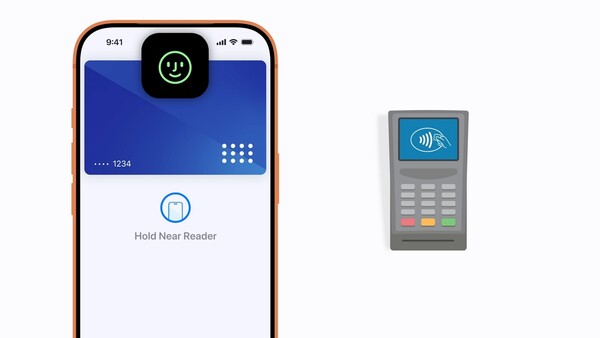
The British government is pushing measures to ease Apple's control over contactless payment technology on iPhones. Apple has opened some functions to external developers, but high fees and strict terms make it difficult for competing services to Apple Pay to emerge.
On Oct. 20, IT outlet 9to5Mac reported that Britain's Competition and Markets Authority (CMA) has begun a public consultation to improve conditions for access to Apple's near-field communication (NFC) technology.
NFC is a technology that wirelessly exchanges information when a smartphone is brought close to a payment terminal. Apple previously allowed the iPhone's NFC payment function only for its Apple Pay, but has allowed some access to external developers after regulatory pressure from countries.
The CMA said the conditions Apple has presented in the UK are not enough to develop competing services. It means high fees and technical constraints are blocking new payment services from entering the market.
Differences with the European Union (EU) have also emerged as an issue. In the EU, external developers with certain qualifications can use NFC payment functions for free. Users can also set a payment app other than Apple Pay as the default wallet. In the UK, by contrast, no mobile wallet service competing with Apple Pay has yet been launched.
The CMA has proposed that Apple allow host card emulation (HCE) in addition to the secure element (SE)-based method it currently provides. Both technologies are used for contactless payments, but differ in how they process payment information.
It also plans to encourage a steep reduction in fees. The CMA is not, however, seeking to set prices directly or make NFC access completely free.
Apple pushed back, saying the existing method supports safe contactless services. It says it cannot agree to regulations that lower standards for privacy protection and security.
The CMA plans to gather views until Nov. 17 before deciding whether to take final measures.
If the regulation is implemented, UK fintech companies are expected to be able to develop various NFC services such as Apple Pay alternatives, digital IDs, transit passes and in-car digital keys.
 Choi Jae-won
ittt_0801@d-today.co.kr