
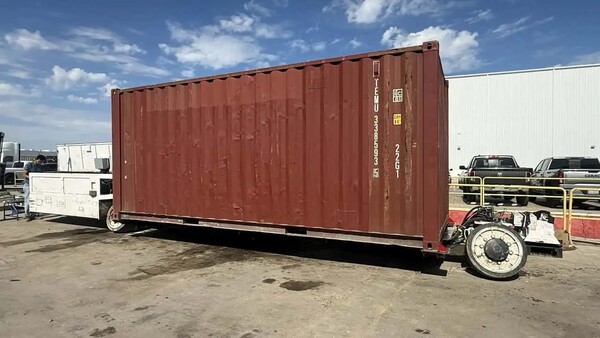
The Boring Company led by Elon Musk showed a remotely operated freight-handling machine using Tesla Model 3 battery packs and drive units moving a standard ocean shipping container inside a tunnel. The effort aims to electrify and automate internal logistics systems for moving heavy cargo in narrow tunnels. The gap between the container and the tunnel wall was extremely narrow, leaving stable remote control as a remaining challenge.
InsideEVs, an electric-vehicle outlet, reported on Oct. 20 local time that the Boring Company released footage of a container being towed by a Model 3-based "Liner Truck". The equipment is designed to carry heavy loads at tunnel-boring sites.
The Boring Company previously introduced the remote-controlled Liner Truck in August. Built using the Model 3 battery pack and drive unit, it is mainly intended to carry precast concrete tunnel segments at excavation sites. The latest footage showed that the existing transport equipment can also tow a standard ocean shipping container.
In the video, the Liner Truck drove through a tunnel carrying the container. Clearance on each side of the container was only about 1 inch. Footage also showed the container’s upper edges appearing close to the tunnel wall. With even small bumps or control errors potentially causing contact with the inner wall, precise control in tight spaces is important.
How it is operated is also a key task. The Boring Company promotes a "Zero People in Tunnel" principle, keeping workers out of tunnels. The Liner Truck is therefore remotely operated. Direct worker intervention can be reduced, but stable remote control is needed to repeatedly move heavy loads safely in tunnels where visibility and space are limited.
Towing capacity is cited as a strength. The Boring Company said the Liner Truck can carry up to 22,000 pounds, or about 10 tons. The company said this is the same as the one-time transport weight of precast concrete tunnel segments. While based on the Tesla Model 3 drivetrain, it is focused on moving heavy construction materials.
Speed and driving range are limited. When towing that weight, it travels at 12 miles per hour, or about 19 km per hour, and has a range of about 28 miles, or about 45 km, per charge. The specifications are suited to moving heavy materials slowly inside tunnels rather than traveling long distances on regular roads.
The emergence of the Liner Truck also aligns with the Boring Company’s push to expand its tunnel business. The company raised $3 billion on Sept. and was valued at $23 billion. Most of the funds came from the United Arab Emirates, and the Boring Company plans to dig a total of 150 km of tunnels there. It has also started additional excavation of 10 miles, or about 16 km, in Nashville, Tennessee.
As tunnel construction expands, internal logistics become more important. Excavation sites require a continuous supply of materials such as concrete liners. The Liner Truck could be used to electrify such transport and raise the level of automation through remote operation.
Compared with the Boring Company’s vision of solving traffic problems, the latest release focuses not on public transport itself but on logistics systems involved in building and maintaining tunnels. The company’s most prominent operating route is a tunnel in Las Vegas spanning several miles. The Liner Truck also appears, for now, to be expanding its use as specialized equipment for excavation sites rather than as a means of public transport.
The key question going forward is how stably remote-controlled equipment can repeatedly transport heavy loads in extremely narrow tunnels. If it proves transport efficiency and safety in large-scale tunnel projects, the Liner Truck could become core logistics equipment supporting the Boring Company’s excavation work.
Using TBC tunnels to transport freight. The latest Prufrock Liner Truck (using Tesla Model 3 batteries and drive units) has been modified to carry a standard 20’ shipping container. Fits like a glove! https://t.co/VV0phWK4fc
 Jinju Hong
hongjj@d-today.co.kr