
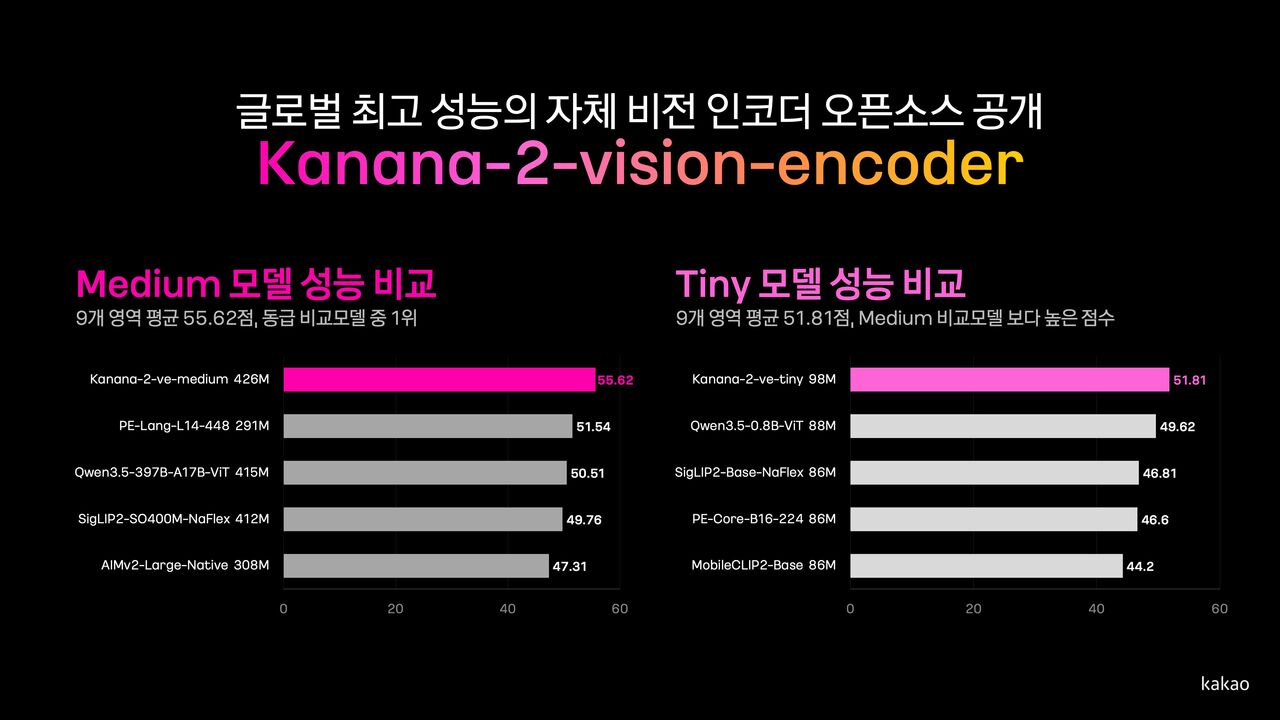
Kakao said on Tuesday it released two versions of its in-house vision encoder, the Kanana-2 Vision Encoder, as open source on Hugging Face.
The newly released models are a 426 million-parameter medium version and a 98 million-parameter tiny version. Kakao previously said at the if(kakao)26 event held on Oct. 13 that it planned to release them.
A vision encoder extracts visual information in an image, including objects, text, location and shape, and passes it to a language model. It handles image understanding in multimodal AI, such as reading menus or documents or grasping situations in photos.
Kakao evaluated performance across 42 benchmarks in nine areas, including general visual question answering, English and Korean optical character recognition and document understanding, identifying locations within images, and fine-grained recognition.
Kakao's internal evaluation found the two models recorded higher performance than global vision encoders used for comparison, including Google's SigLIP 2, Meta's Perception Encoder, Apple's AIMv2 and Alibaba's Qwen3.5-ViT.
The company said the tiny model is a lightweight model with fewer than 100 million parameters and showed performance differences versus comparison models in identifying locations within images, Korean tests, and Korean OCR and document understanding.
Kakao said it used its in-house language model, Kanana-2, to train the vision encoder, raising training efficiency by about four times versus the previous level. It said it also cut processing latency by more than 60 percent compared with major global comparison models by applying a design tailored for high-resolution image processing.
It also applied knowledge distillation and model-lightweighting techniques. Through this, it developed the tiny model designed with on-device use in mind, along with the medium model.
Both models use the Kanana Open License, which allows use not only for research and development but also for commercial purposes.
Kakao is developing in-house technologies that make up its omni language model Kanana-o, including language models, the vision encoder and visual and speech processing modules. It plans to sequentially release other components in the future.
Byung-seok Noh (노병석), performance leader for Kakao's unified foundation model, said, "As computer use technology that directly understands and operates computer screens draws attention, the role of vision encoders that accurately analyze high-resolution images is also growing." He added, "We will strengthen the competitiveness of our in-house AI models and continue to disclose related technologies."
 Ho-jung Lee
lhj@d-today.co.kr