
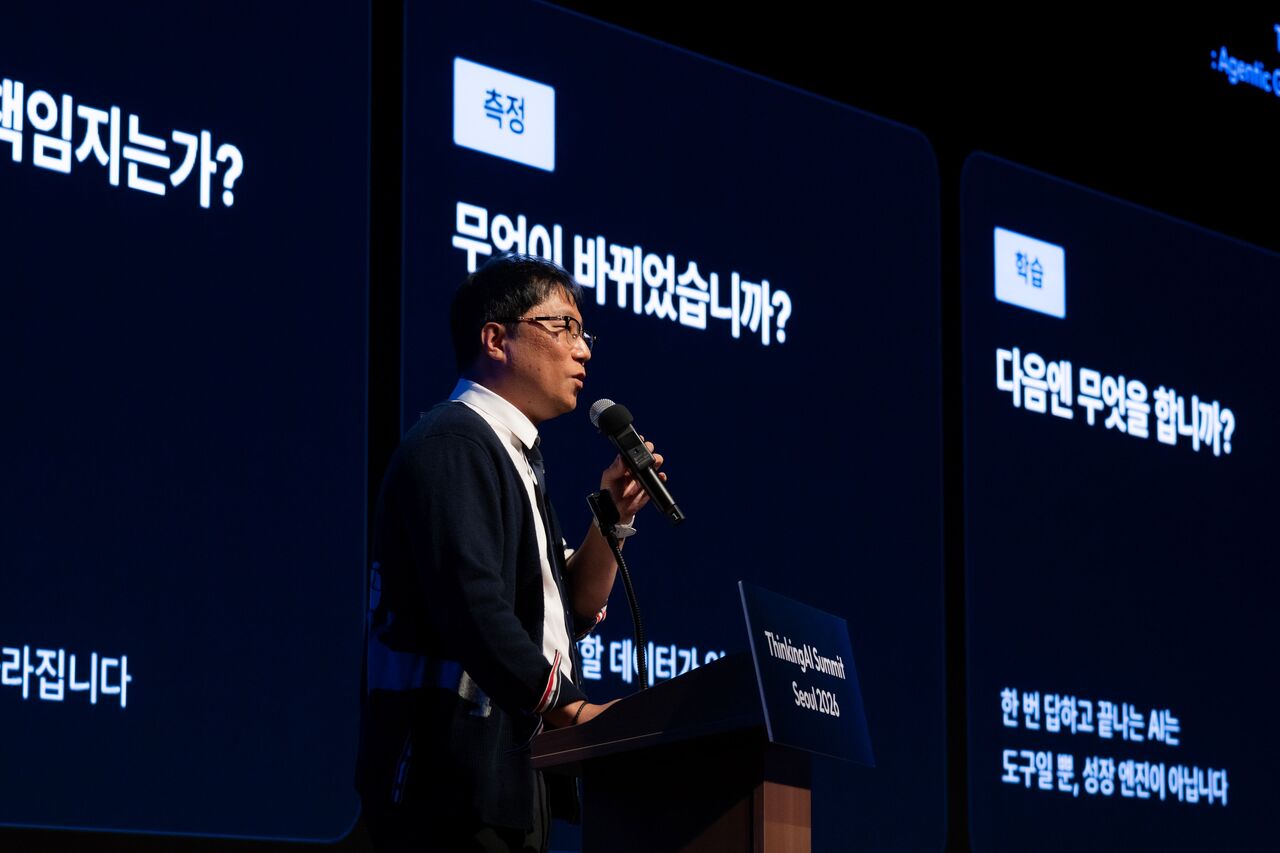
ThinkingAI, an agentic AI platform company, held ThinkingAI Summit Seoul 2026, or TAS, on Oct. 20 at the Textile Center in Seoul’s Gangnam district and shared cases of using AI agents across various fields including games, finance and education.
Under the theme of Agentic Growth, ThinkingAI presented ways to spot changes in data, analyse causes and reflect execution results in the next action, along with real cases.
Kwang-deok Seo (서광덕), head of ThinkingAI’s Korea branch, said the era has arrived in which people handle only direction-setting and approval while agents execute. He stressed that companies must first establish the meaning of data and role-based authority and responsibility, and that a process is essential to ensure AI can work within approved boundaries.
Seo also said companies should be able to keep using the data and work knowledge they have accumulated even if AI models change. He said the company will continue to support businesses so they can apply AI analysis to product improvements and customer response and translate that into tangible business results.
The event also introduced ways to use an “agentic engine” to support such workflows. Seung-joo Lee (이승주), sales director at ThinkingAI, described a structure that links customer analysis, campaign design, execution based on human approval and result checks within a single solution. He also presented a case in which health functional food direct-to-consumer mall Honestree integrated advertising, behaviour and order data by customer to distinguish re-contact targets from those to exclude. Lee said LLMs themselves have become easier to use, but people must build and maintain the structure in which LLMs can work.
In the corporate case sessions, the focus was on processes that turn analysis results into work actions.
Gil-woo Ha (하길우), a lead on the product strategy team at Class101, said the time needed to gain key insights fell to 1 day from 3 days as AI analysed experiments by referring to planning documents, discussion contents and code.
He also explained, through a case that interpreted why customers hesitate to pay and linked it to follow-up actions, how to reflect experiment outputs in the next execution process. Ha added, “If the direction of experiment results is ambiguous, AI accelerates that ambiguity (in a bad direction),” stressing again the importance of team-level verification standards.
Underdogs shared its experience of using AI to analyse data accumulated on its platform by a six-member development team to respond to user churn. Min-seok Kang (강민석), co-founder, explained that it analysed and verified the relationship between combat losses in the game and user churn, then planned content in which fallen soldiers return. He said it took 3 days from the point a user was attacked to finalising an improvement plan, adding that agents handled development and people handled only review and service deployment. He also said know-how usually leaves when the person responsible leaves a company, but at his company know-how remained as an agent’s knowledge, allowing it to retain that know-how.
The event also highlighted changes in game development collaboration procedures driven by AI adoption.
Seung-hyun Lee (이승현), Seed director at Bluehole Studio, said game designers first create playable outputs using AI and the team reviews them together, sharply reducing interpretation gaps that arise when communicating planning intent through documents. He said the time to add a single new weapon fell to 1 day from 20 days based on elapsed time, adding, “What is slow is not the speed of making, but the communication time spent on understanding and coordination.”
As more tasks are assigned to AI, standards for verifying outcomes also become more important.
Dong-jin Seo (서동진), head of the AI Data Platform Team at Next Securities, shared an experience of building a data platform that records request intent and reasons for choices for use in the next task, while filtering rule-breaking changes through automatic checks. Seo said it is more important than how much AI is used to decide what work is assigned to AI and how much responsibility can be taken for the results.
A discussion on organisational operations included Jun-young Jeon (전준영), head of the Game Business TF at ONE store, and Seung-kwon Kim (김승권), chief executive of Joshua & Company, known as “Builder Josh.” Jeon introduced a method that separates writing agents and review agents and reflects approval and feedback in subsequent work. Kim shared an operating structure in which 11 agents perform repetitive tasks in a six-person organisation, while members are responsible for profit and loss and execution for each business. Jeon summed it up by saying, “What you delegate is not the task, but the standard.”
Seo, head of ThinkingAI’s Korea branch, said companies should be able to keep using the data and work knowledge they have accumulated even if AI models change. He said the company will continue to support businesses so they can apply AI analysis to product improvements and customer response and translate that into tangible business results.
 Chi-gyu Hwang
delight@d-today.co.kr