
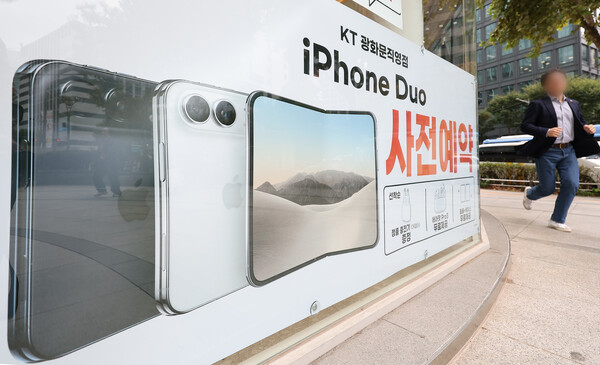
[DigitalToday, by Jin-ho Lee] Apple’s first foldable smartphone, the iPhone Duo, is showing signs of an early hit. Despite a price above 3 million won, orders are pouring in and delivery dates on Apple’s official online store have been pushed back to January next year. Some analysts say it is hard to judge real demand from sellouts alone, as initial supply is believed to be limited.
The telecom industry said on Oct. 21 that iPhone Duo preorders began in South Korea on Oct. 16. The official launch date is Oct. 23. The market had expected preorders to surge early on, driven by anticipation for Apple’s first foldable device. Some also said users familiar with the iPhone operating system and Apple devices may see it as a reason to try a foldable phone without switching to another brand.
In practice, initial stocks of the iPhone Duo are being depleted quickly, leading to long waits for delivery. On Apple’s official online store, the expected South Korea delivery date for the iPhone Duo 256GB Star White model is listed as Jan. 22, 2027. That is about three months after the official launch date. Similar delays have appeared in the United States, with expected delivery dates pushed into next year.
The three South Korean mobile carriers are seeing a similar situation. SK Telecom, KT and LG Uplus are taking preorders based on secured initial allocations and expected supply schedules. Some carriers are splitting preorder rounds to reflect initial inventory. A carrier official said, “Preorders are coming in quickly relative to the secured supply,” adding that “global supply itself is limited.”
The three carriers have not disclosed specific preorder results or initial allocation volumes. Because each carrier has different secured volumes, it is difficult to interpret sellouts at a particular sales channel as strong sales across the broader market.
Initial supply shortages delay deliveries... what is real demand?
Unlike existing iPhones, the iPhone Duo applies new components such as a foldable display and hinges. With a complex production process and the need to meet quality standards for each component, initial production yield is seen as a key variable determining supply. Overseas supply chains have raised issues with production yields for hinges and ultra-thin glass (UTG). With foldable phones more structurally complex than typical smartphones, lowering defect rates in final assembly is also important.
Brokerage firms also pointed to yield issues as a variable for smooth device supply. Meritz Securities, in a report on Oct. 19, said initial demand for the iPhone Duo had been confirmed but weak yields in key components and at the final assembly stage were making it difficult to scale up production.
Yang Seung-su (양승수), an analyst at Meritz Securities, said, “In addition to yield issues in key components such as the external hinge and ultra-thin glass (UTG), poor yields at the original equipment manufacturing (OEM) stage are also occurring, making it difficult to expand production.” He added, “To achieve this year’s shipment target of 6 million units, the possibility is being highlighted that component orders may be expanded to account for yield losses.”
Even if Apple increases component orders, it is expected to take time before supplies of finished products rise. That is because both component procurement and assembly yield improvements must occur at the same time. As a result, there are also views that the initial supply shortage may not be resolved quickly.
Even so, the telecom industry says it remains to be seen whether initial delivery delays will lead to prolonged supply turmoil. It is also unclear whether early interest will translate into longer-term sales expansion. That is because demand from early adopters seeking to experience Apple’s first foldable phone quickly may have been concentrated in preorders.
A carrier official said, “Even if the number of preorders exceeds the number of devices prepared, preorders will continue until the set schedule,” adding, “If additional devices are secured later, devices will be supplied in preorder order.”
Price above 3 million won also a variable... three carriers compete to reduce purchase burden
Along with supply shortages, the high price is also seen as a variable for future sales growth. With the iPhone Duo’s retail price above 3 million won, lowering the burden is important to sustain early buying interest.
The three carriers are focusing on reducing the purchase burden with used-phone trade-in compensation, co-branded card discounts and device replacement programs. SK Telecom offers benefits worth up to 2.21 million won by combining used-phone trade-ins and co-branded card discounts. KT is running co-branded card discounts, plan bundles and device care programs. LG Uplus has strengthened a program that compensates part of the retail price if a device is returned after being used for a set period.
The telecom industry also suggests that competition in selling high-priced smartphones may expand beyond device discounts to include post-purchase care and replacement. Given the high retail prices of foldable phones, an analysis says how much carriers can reduce both initial purchase costs and future replacement burdens could become an important competitive factor.
The telecom industry is also making an all-out effort to secure additional shipments. But with initial supply limited, it is unclear when supply and demand will normalize. If preorder demand continues, the waiting period for receiving devices could become longer.
An industry official said, “The fact that inventory has been depleted quickly from the beginning of preorders means interest is that high,” but added, “Since initial supply itself was not large, whether it is truly a hit will only be known after tracking sales trends once additional supply is delivered.”
 Jin-ho Lee
jhlee26@d-today.co.kr