
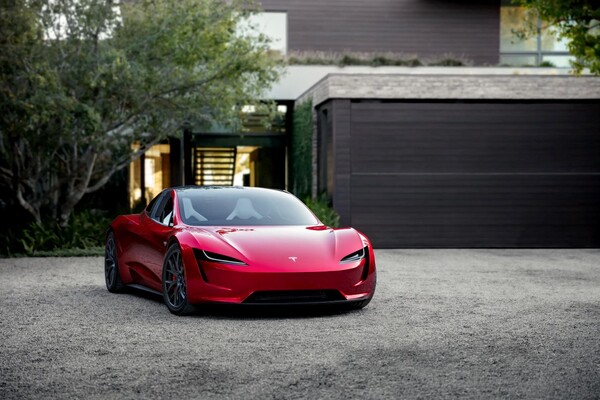
Tesla's next-generation Roadster is set to be unveiled as a production model after about nine years of waiting. But with growth in the electric vehicle (EV) market slowing and Tesla's business direction shifting to autonomous driving and robots, questions are being raised over how much significance its late arrival will have.
On Oct. 14, local time, U.S. tech outlet The Verge reported that Tesla plans to unveil the next-generation Roadster in Waco, Texas. Elon Musk has claimed the car will reach 60 miles per hour from a standstill in under 2 seconds and have a top speed exceeding 250 miles per hour. He has also said the optional "SpaceX package" applies cold-gas thrusters that can allow the car to briefly lift off the ground. Those performance claims and features still need to be verified in a production car.
The market environment at launch is not favorable. In the United States, automakers are scaling back related plans amid slowing EV sales and consumer uncertainty, and Tesla is also facing falling demand and lowered expectations. Doubts about the Roadster's feasibility have accumulated after repeated delays, and some reservation holders, including OpenAI Chief Executive Sam Altman (Sam Altman), have cancelled their orders.
It may also be harder to stand out in performance competition than in the past. Tesla put the Model S Plaid's 0 to 60 mph acceleration time at 1.99 seconds in 2021, and similar performance was later confirmed in independent tests. Electric motors have made it easier to boost straight-line acceleration, but heavy batteries can reduce a sports car's agility in cornering and track driving.
Weakness in the high-priced electric hypercar market is another burden. The Rimac Nevera, Pininfarina Battista and Lotus Evija showed strong performance but suffered weak sales and production delays. Bugatti CEO Mate Rimac (Mate Rimac) said that despite setting multiple records with the more-than-1,900-horsepower Nevera, it had been difficult to sell the planned 150 units. An analysis says buyers of ultra-expensive cars value emotional factors such as brand, engine sound and shifting feel, as well as acceleration.
Rivals are also rethinking their pure electric sports car strategies. Ferrari designed its first electric car as a four-door model, and Porsche has repeatedly delayed converting the 718 Cayman and Boxster to pure electric versions. Lamborghini has also dropped its pure EV plan and shifted its focus to hybrids.
Even within Tesla, the center of gravity in its car business is changing. Musk has said the Roadster will be Tesla's last vehicle designed for people to drive themselves. Tesla has ended production of the Model S and Model X and is putting weight behind production of its humanoid robot Optimus, and it has also mentioned the possibility of merging with SpaceX.
The Roadster does not have to succeed in mass sales to matter to Tesla. With the Model 3 and Model Y already established as the company's leading success models, the Roadster could aim for scarcity and brand symbolism as a limited-production ultra-expensive car. Still, as Tesla's interest shifts to artificial intelligence (AI), autonomous driving and space-based infrastructure, the Roadster could end up as a car that belatedly realizes an old vision of the future.
 Seungah Yoo
ysah@d-today.co.kr
Seungah Yoo
ysah@d-today.co.kr