
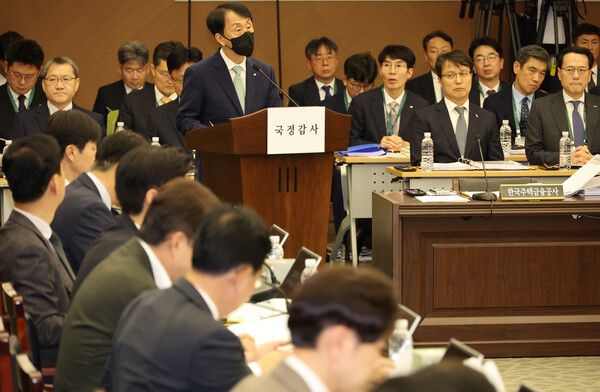
At a parliamentary audit by the National Assembly’s political affairs committee, lawmakers raised a series of issues involving the share of public institutions’ deposits held by regional banks, differences among banks in the time required to execute reverse mortgage loans, and funding constraints for long-term fixed-rate mortgage lending. They said changes are needed to improve criteria for selecting transaction banks by public institutions to revitalise regional finance, shorten reverse mortgage payment procedures, and reform systems to support banks’ long-term funding.
At the audit on Oct. 15 of financial public institutions including Korea Asset Management Corp (KAMCO) and Korea Housing Finance Corp, issues related to fund management and improvements in financial services in the banking sector were discussed.
BU SAN PUBLIC DEPOSITS AT 7.07 TRILLION WON; BUSAN BANK SHARE 14.9 PERCENT
Park Seong-hoon (박성훈), a lawmaker from the ruling People Power Party, urged changes to criteria for selecting transaction banks to revitalise regional finance. He said large funds held by public institutions that relocated to Busan are concentrated at nationwide commercial banks rather than regional banks.
Data Park presented showed total deposits of nine public institutions that relocated to Busan last year amounted to 7.07 trillion won. Of that, funds deposited at BNK Busan Bank stood at 1.05 trillion won, or 14.9 percent of the total.
Park said the core justification for relocating public institutions to provincial regions is to revitalise local economies. He said depositing large operating funds with Seoul-area commercial banks rather than regional banks fails to meet the purpose of preventing an outflow of local funds and creating a virtuous cycle in local economies.
He also raised the issue that deposit standards for financial public institutions that relocated to Busan, including Korea Housing Finance Corp, do not sufficiently reflect contributions to the local economy.
Park said he has proposed amendments to the Act on the Management of Public Institutions and the Innovation City Act. The amendments would reflect performance in using regional financial institutions in evaluations of public institutions’ management performance and impose a duty to make efforts to deposit surplus funds with banks headquartered in the relocated region.
He said the aim is not to force the use of regional banks, but to link contributions to the local economy with management evaluations while considering the profitability of fund management so public institutions have their own incentives.
In response, Korea Housing Finance Corp said it gives priority to offered interest rates when selecting deposit institutions. If interest rates are the same, it compares banks’ rating grades, and if those are also the same, it selects the institution with a smaller deposit balance.
Kim Kyung-hwan (김경환), CEO of Korea Housing Finance Corp, said it created a co-prosperity fund with Busan Bank and provided 20 billion won last year and 22.5 billion won this year, supporting loans to local small and medium-sized firms. He said the company would seek ways to revitalise transactions with regional banks if the relevant bill is 마련ed.
REVERSE MORTGAGE PAYOUTS ALSO VARY BY BANK; KB KOOKMIN AND WOORI RELATIVELY SLOW
Lawmakers also said the time it takes for reverse mortgage subscribers to receive loan funds after receiving a guarantee certificate differs widely by bank.
Han Min-soo (한민수), a lawmaker from the Democratic Party, said at the audit of Korea Housing Finance Corp that from January to September this year there were 13,889 cases of reverse mortgage loan execution. He said it took an average of more than 31 days from application receipt to actual loan execution.
He said it took an average of 7.2 days from when the corporation issued a guarantee certificate to when the bank executed the loan, and there were 4,631 cases that took more than 1 week. There were also 216 cases that took more than 1 month.
Differences by bank were also seen. Han said Shinhan Bank and Hana Bank had loan execution periods that were short at about half the overall average, while Woori Bank and KB Kookmin Bank were close to 10 days or exceeded that level.
He also said the share of cases taking more than 1 week was about 1 out of 10 at Shinhan Bank and Hana Bank, while it was more than 5 out of 10 at Woori Bank and KB Kookmin Bank.
Han said such differences should not occur depending on which bank someone chooses when first applying for a reverse mortgage. He said older people want to receive pension payments immediately and a month can make a big difference in their lives.
He called for identifying the causes of the differences in processing times by bank and preparing improvement measures.
Kim said there could be differences in when customers visit banks after receiving guarantee certificates, and factors such as work proficiency by financial institutions could also have an impact. He said the corporation will review conditions focusing on banks with longer processing times and manage them to reduce disparities among banks.
BANKS’ LONG-TERM FIXED-RATE MORTGAGES; NEED TO INVIGORATE COVERED BONDS RAISED
The audit also discussed improving funding structures to expand long-term fixed-rate mortgage lending in the banking sector.
Lee Kang-il (이강일), a Democratic Party lawmaker, pointed to a structure in which banks handle long-term mortgage loans while funding is raised on a relatively short-term basis. He said the covered bond market needs to be invigorated.
Covered bonds are bonds issued by financial institutions backed by sound assets such as mortgage loan receivables and are used as a tool for raising long-term funds.
Lee said the domestic covered bond market has not grown sufficiently even after relevant legislation was enacted. He said won-denominated covered bond issuance, which had been suspended since 2021, resumed with Korea Housing Finance Corp’s payment guarantees, but issuance over the 3.5 years through the end of last year totalled only 2.04 trillion won.
He also said that to expand banks’ long-term fixed-rate lending, it is necessary to attract long-term investment funds from overseas pension funds and insurers into South Korea.
He proposed expanding domestic banks’ issuance of covered bonds overseas and improving systems so Korea Housing Finance Corp’s payment guarantees can also be used for overseas issuance. He said it is also necessary to 마련 a credit enhancement framework to attract overseas investors and expand the covered bond secondary market.
Lee said that long-term fixed-rate loans can grow only if banks secure stable long-term funding. He said it should be developed into a new source of financing that links overseas long-term funds with domestic housing finance.
Kim said he agreed incentives are needed to expand long-term fixed-rate mortgage lending by commercial banks. He said the corporation provides payment guarantees for covered bonds issued by private banks, and that 2 regional banks last year successfully issued bonds using this.
He said that if amendments to the corporation’s law are made in relation to support for overseas issuance, it will explore ways to expand overseas covered bond issuance together with commercial banks.
He added that to expand overseas issuance, related conditions such as investor demand in European markets and the government’s annual cap on overseas issuance also need to be considered.
 Ji-young Lee
ljy@d-today.co.kr
Ji-young Lee
ljy@d-today.co.kr