
[Digital Today reporter Seulgi Son] "It usually takes 50 to 60 people to produce a single dubbed version. If you dub into 10 languages, that means 500 people take part."
Catherine LeTarte, Netflix's senior director for global content localisation, said this on Oct. 15 at the Global Localisation Roundtable held at the Four Seasons Hotel in Seoul.
Netflix unveiled its subtitling and dubbing production system and localisation strategy that supports the global spread of Korean content. It said it deploys dozens of specialists for each language to supply content to overseas markets and has built a production network with partners around the world.
LeTarte said many people take part, including voice actors and translators, dubbing script adapters, directors, sound engineers and quality inspectors. She stressed that dubbing is not a secondary task and that localisation is effectively a second production.
Netflix currently has the capability to provide dubbing in 36 languages and subtitles in 33 languages. It is carrying out localisation work with a total of 122 partners across four regions: the United States and Canada, Europe, the Middle East and Africa, Asia-Pacific, and Latin America.
Localisation work is expanding as Korean content finds global success. Netflix said 80 percent of its members worldwide have watched Korean content, and more than 200 Korean titles have entered the global Top 10 so far.
Director Lee Chang-dong's new film, "Possible Love", due to be released on Nov. 6, will be provided with subtitles in 32 languages and dubbing in 18 languages. It will also support audio description in 10 languages for the visually impaired and subtitles in 3 languages for the hearing impaired.
The discussion also introduced localisation work aimed at conveying cultural expressions unique to Korean to overseas viewers.
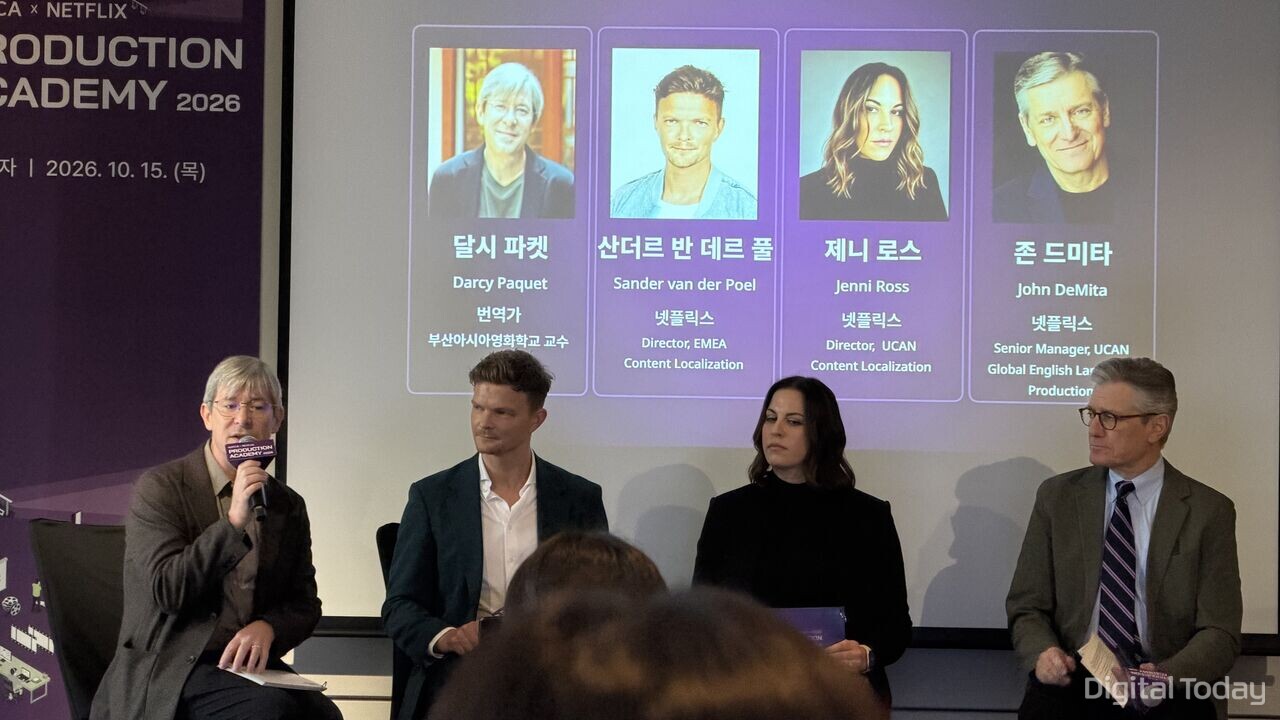
Translator Darcy Paquet, who handled the English subtitles for "Possible Love", cited a scene in which another character is surprised to see a couple call the husband by his name. He explained that he judged a literal translation of the line could cause overseas audiences to misunderstand Korean culture, and after discussing it with director Lee Chang-dong and the production team, he used the Korean expression "oppa" as is in the English subtitles.
There were also questions about AI-based translation and dubbing technology. Netflix said AI could be a tool to support the work of creators and professionals but would not replace them. It stressed that the role of human experts is important, especially for delicate emotional expression.
The event was held in conjunction with a global content localisation workshop jointly organised by the Korea Creative Content Agency and Netflix.
 Seulgi Son
sageson@d-today.co.kr
Seulgi Son
sageson@d-today.co.kr