
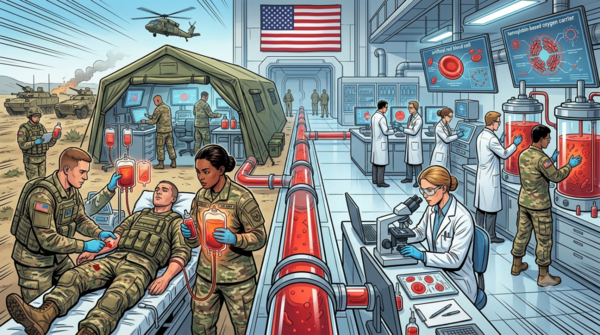
The U.S. Defense Advanced Research Projects Agency (DARPA) is developing blood substitute components that can be stored for long periods at room temperature to address blood shortages on the battlefield. The idea is to create plasma, platelets and red blood cells in forms that can be stored long term and supplied quickly to wounded people who need transfusions.
MIT Technology Review reported on Oct. 14 that DARPA is pushing development through a new $73 million research programme called Rapid, or RAPIID. The programme aims to extend the shelf life of blood components, with a goal of field deployment in 2029.
The project focuses on reducing limitations that arise during the storage and transport of donated blood. Whole blood can be stored for only about 35 days even under refrigeration, and platelets struggle to last even a week at room temperature. Frozen red blood cells and plasma also must be used within days once thawed.
Because it is difficult to predict when attacks will occur on the battlefield, it is not easy to thaw blood in advance. Robert Murray (로버트 머리), a DARPA programme manager, pointed out that once blood is thawed, the discard deadline begins regardless of whether it is used. If blood substitute components that can be stored at room temperature for long periods are developed, supplies could be managed more flexibly even on battlefields that lack refrigeration and freezing facilities.
A driver behind the push is bleeding, which is directly linked to survival odds for trauma patients on the battlefield. The report said about 90 percent of preventable battlefield deaths are related to bleeding. A JAMA study analysing combat injury data from Afghanistan said about 36 minutes after injury can be a decisive time that determines survival for wounded people who need transfusions.
Murray said it is important to supply blood quickly to injured people who are bleeding. He said transfusion within an appropriate time can increase the chance of survival, but if the response is delayed, the survival rate can drop sharply. DARPA aims to reduce these time constraints by storing blood components for long periods and making them available for immediate use when needed.
DARPA has previously studied animal test-based blood substitute technology through its FSHARP programme. RAPIID is a project that advances this research to a stage closer to actual field deployment.
Candidate technologies will be tested in parallel. The plan is to focus in the first year on large-animal studies, manufacturing processes and regulatory work, and then pursue human trials in years 2 and 3 under the supervision of the University of Colorado Anschutz Medical Campus. The programme will also examine potential use in emergency medical settings such as ambulances transporting severely injured trauma patients.
Among the three blood components, the area with relatively more progress is plasma. The United States has been rebuilding its freeze-dried plasma production capacity since 2010, and in the past 2 years the U.S. Food and Drug Administration has allowed 2 freeze-dried plasma products that the U.S. military can use in emergencies. One of the products can also be used in the civilian sector.
Platelet substitute technology is more complex. Platelets help blood clot at bleeding sites and are also involved in inflammatory responses, making it difficult to replace their function with a substance that simply hardens blood.
SynthoPlate, under development by researchers at Case Western Reserve University, is designed by attaching multiple peptides to the surface of lipid nanoparticles so they adhere to sites of vascular injury like real platelets. The researchers said in a paper published in 2026 that the substance reduced bleeding time and blood loss by more than half in mice with low platelet counts.
Anilban Sen Gupta (아닐반 센 굽타), who leads the research, compared platelets to drones that detect and respond to damage to blood vessel walls rather than being a simple clotting substance. He said that for platelet substitute technology to be used in real medical settings, it must consider such complex biological roles as well as the function of suppressing bleeding.
Red blood cell substitutes have long remained an unresolved challenge. In the past, haemoglobin-based oxygen carriers faced difficulties in clinical development due to vasoconstriction and cardiovascular side effects. Recently, an approach to reduce side effects by wrapping haemoglobin in an artificial membrane has again drawn attention.
ErythroMer, being developed by biopharmaceutical company KaloCyte, aims to store at room temperature for up to 2 years haemoglobin recovered from donated blood, packaged in lipid nanoparticles. The company said animal tests showed blood pressure and oxygen delivery remained stable, and severe vasoconstriction seen as a problem in past candidates was not observed.
However, securing raw materials is an obstacle to commercialisation. The haemoglobin that can be obtained from blood nearing expiration is currently about 1,000 to 2,000 units a month. KaloCyte is also reviewing an in-house production method using yeast to increase output.
DARPA earlier this month allocated additional funding to blood component-related technologies at 5 companies, in addition to ErythroMer and SynthoPlate. AvioRemedi is developing synthetic versions of other oxygen-carrying proteins such as cytoglobin, neuroglobin and myoglobin instead of haemoglobin. Octapharma USA secured a plasma contract to supply the RAPIID programme, and in the platelet field it is also developing nanoparticle technology that combines 2 clotting proteins.
Still, it remains uncertain whether the technologies under development can prove effective in real medical settings. Shibani Pati (샤이버니 파티), head of a University of California, San Francisco research centre, offered the view that it may be more realistic to advance technologies whose safety and efficacy in humans have already been confirmed to the FDA approval stage. Murray, by contrast, said the strategy is to develop multiple candidate technologies at the same time to prepare for various variables that could arise in manufacturing and regulatory processes.
Challenges also remained in animal testing under the earlier FSHARP programme. When multiple blood substitute components were administered together, they met most evaluation criteria, but clotting performance was somewhat lower than whole blood. This means developing plasma, platelets and red blood cells separately may not be sufficient to fully reproduce the functions needed for real transfusions.
John Holcomb (존 홀컴), a professor at the University of Alabama at Birmingham, also said the products under development are unlikely to perfectly replace all the functions of whole blood. Still, what patients with massive bleeding need may not necessarily be a complete replication of whole blood. He said that if substitutes can suppress bleeding and deliver oxygen to secure the time needed for survival, they could still produce meaningful results.
Ultimately, the success of the RAPIID programme does not stop at making plasma, platelets and red blood cells storable for long periods. The key is whether each component is effective on its own and whether, when used together, they can replace to some extent the functions of real whole blood. For DARPA's 2029 field deployment goal to be realised, safety, efficacy and the feasibility of mass production will also need to be demonstrated.
 Jinju Hong
hongjj@d-today.co.kr
Jinju Hong
hongjj@d-today.co.kr