
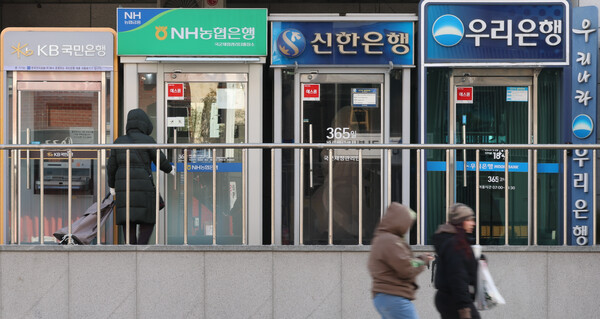
Household loans across South Korea’s entire financial sector fell 2.2 trillion won last month, the first net decline this year. The drop came as growth in mortgage loans slowed while other loans, including credit loans, fell sharply. Mortgage loans still rose by more than 3 trillion won, and financial authorities decided to maintain their household debt management stance through year-end.
The Financial Services Commission said in its preliminary "September 2026 Household Loan Trends" released on Wednesday that household loans across the financial sector fell 2.2 trillion won from the previous month. It was the first decline since December last year, nine months earlier.
Household loans across the financial sector rose 9.3 trillion won in May, 8.3 trillion won in June, 6.4 trillion won in July and 2.8 trillion won in August before turning to a decline in September.
Mortgage loans rose 3.3 trillion won, down 1.0 trillion won from the previous month’s 4.3 trillion won increase. Banks’ mortgage loan growth slowed to 2.9 trillion won from 4.1 trillion won, while non-bank lenders expanded to 400 billion won from 200 billion won.
Other loans fell 5.5 trillion won, widening from a 1.5 trillion won decline the previous month. In particular, the decline in credit loans widened to 3.0 trillion won from 400 billion won, contributing to the fall in overall household lending.
Banks’ increase narrows... non-bank lenders down 2.8 trillion won
By sector, household loans at banks rose 600 billion won, sharply slowing from a 3.5 trillion won increase the previous month.
Banks’ own mortgage loans rose 1.8 trillion won, down from 2.9 trillion won. Growth in policy loans such as Didimdol and Beotimmok held steady at 1.1 trillion won from the previous month. Other loans fell 2.3 trillion won, deepening the decline from the month before.
Household loans at non-bank lenders fell 2.8 trillion won, extending the decline from 700 billion won the previous month.
Mutual finance cooperatives fell 700 billion won, insurers fell 800 billion won, and specialized credit finance companies fell 900 billion won. Savings banks shifted to a 400 billion won decline from a 300 billion won increase the previous month.
Financial authorities assessed that September’s decline reflected housing market factors such as lower housing transactions and fewer move-ins, as well as seasonal factors including end-of-quarter sales and write-offs of non-performing loans and holiday bonuses.
Authorities said household loans have turned to a decline, but they plan to maintain their management stance in consideration of expectations of rising house prices and the possibility of greater volatility in credit loans.
Earlier, financial authorities raised the annual growth-rate target for total household loans at financial institutions to around 3.0 percent from 1.5 percent. They also decided to manage group loans such as relocation loans, interim payment loans and balance payment loans separately from each financial firm’s total volume management target.
Shin Jin-chang (신진창), the FSC’s secretary general, said at a "household debt inspection meeting" on Wednesday that the measures are expected to limit concerns about a year-end lending cliff, while calling for continued management of risk factors such as expectations of rising house prices and credit loan volatility.
From the 19th, Bogeumjari Loan marriage penalty to be resolved... youth jeonse guarantee to expand
Financial authorities also reviewed follow-up steps to real estate financial measures announced on Aug. 13.
Income requirements for newlywed couples for Bogeumjari Loans will be revised from the 19th. Previously, income thresholds of 70 million won for unmarried applicants and 85 million won for newlyweds applied. Going forward, the rules will be changed to reflect cases such as where one spouse has an annual income of 70 million won or less.
Support for jeonse loan guarantees under special provisions for young people without a home will also be expanded. The eligible age will be raised to 39 and under from 34 and under, and guarantee limits for newlywed couples and households with children will be increased to 300 million won from 200 million won.
Financial authorities also reviewed the status of group loans for newly built apartment complexes moving in. Under the Aug. 13 measures, group loans for newly built move-in complexes were excluded 100 percent from each financial firm’s total volume management target.
Shin said, "Please thoroughly verify and inspect within the financial sector so that end-users can receive loans without disruption in line with the financing plans they anticipated at the time of subscription."
 Ji-young Lee
ljy@d-today.co.kr
Ji-young Lee
ljy@d-today.co.kr