
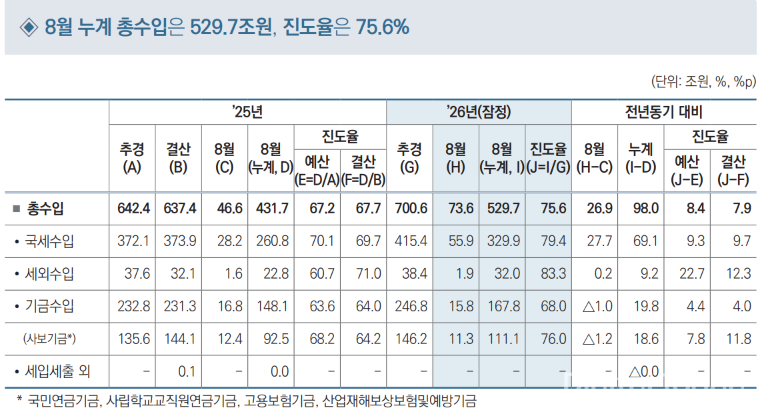
South Korea's fiscal deficit through August narrowed to 43 trillion won, the smallest in eight years. Higher corporate tax revenue from improved company results and an expansion in national tax revenue including income tax led the improvement in the fiscal balance.
The Ministry of Economy and Finance said in its October issue of Monthly Fiscal Trends, released on Wednesday, that the cumulative managed fiscal balance from January to August was a 43 trillion won deficit. That was an improvement of 45.3 trillion won from a 88.3 trillion won deficit a year earlier, and the smallest deficit since 2018.
The managed fiscal balance is a measure that excludes the balances of social security funds such as the National Pension from the consolidated fiscal balance, which is total revenue minus total spending. It shows the government's actual fiscal position.
An increase in national tax revenue played a major role in improving the fiscal balance. Cumulative total revenue for January to August was 529.7 trillion won, up 98 trillion won from a year earlier. National tax revenue was 329.9 trillion won, an increase of 69.1 trillion won year on year.
In particular, corporate tax revenue rose 28.2 trillion won from a year earlier to 91.6 trillion won on the back of improved company results. Corporate tax collections totalled 39.7 trillion won in August alone. The inflow reflected a concentration of revenue during the interim corporate tax payment period amid strong company results.
Income tax also increased 14.4 trillion won from a year earlier to 101.1 trillion won. Factors included an expansion in earned income tax due to higher performance bonuses and an increase in capital gains tax on higher property transaction volumes.
More active stock market trading also contributed to higher tax revenue. The securities transaction tax rose 7 trillion won to 9.2 trillion won due to increased trading value and a restoration of the tax rate. The rural special tax increased 9.5 trillion won, helped by rising KOSPI trading value and other factors. Value-added tax increased 7.4 trillion won due to higher imports and private consumption.
Total spending for the same period was 524.7 trillion won, up 39.3 trillion won from a year earlier. As the increase in total revenue outpaced the rise in spending, the consolidated fiscal balance posted a 5 trillion won surplus. That was an improvement of 58.8 trillion won from a 53.7 trillion won deficit a year earlier.
The cumulative consolidated fiscal balance posting a surplus for January to August is the first since 2018.
Still, as this improvement in the fiscal balance reflects the effect of tax inflows from interim corporate tax payments in August, it remains to be seen whether it will lead to an improvement in the full-year fiscal balance.
Government debt continued to increase. Central government debt stood at 1,372.1 trillion won as of end-August, up 17.9 trillion won from the previous month. It was up 104 trillion won from end last year.
Of the total, the outstanding balance of Treasury bonds was 1,263.5 trillion won, up 102.1 trillion won from end last year. Over the same period, the outstanding balance of foreign exchange stabilization fund bonds increased by 4.7 trillion won, while the outstanding balance of national housing bonds decreased by 2.8 trillion won.
 Seulgi Son
sageson@d-today.co.kr
Seulgi Son
sageson@d-today.co.kr