
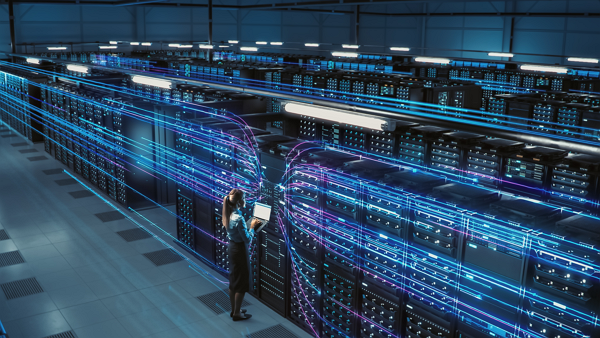
A claim has emerged that artificial intelligence (AI) data centres are using about 40 percent of their electricity inefficiently.
On Oct. 14 local time, IT outlet TechRadar reported that Nvidia said power bottlenecks at AI data centres could become a bigger constraint than chip shortages.
The remarks came at data centre builder Vertiv's annual Europe, Middle East and Africa (EMEA) event. Nvidia and Vertiv have been working on a joint next-generation data centre design from early 2026, and Vertiv is responsible for power and infrastructure management for Nvidia graphics processing units (GPUs).
Nvidia said that at most 70 percent of the electricity supplied from the grid to data centres is used for actual AI computing. The remaining 30 percent is consumed by infrastructure operations and system inefficiencies, and in some cases that share can rise to 40 percent. Based on a 1 gigawatt (GW) data centre, it said 20 percent is consumed in cooling and power distribution and conversion, with an additional 10 percent wasted due to rack configuration errors and system failures and restarts.
Rhode Evans (로드 에번스), Nvidia vice president for EMEA supercomputing, AI cloud infrastructure and AI/HPC, pointed to a significant gap between contracted power and the power actually delivered. "Even if you sign a contract for 100 megawatts (MW), you do not actually receive all that power," he said. "If you are lucky you might get 93 MW, or you might get less," he said.
Nvidia believes some of these losses can be reduced by using idle capacity and adjusting power and cooling configurations. Evans said data centres are designed to prepare for peak loads and failures rather than typical usage, and said the spare capacity secured in that process needs to be used efficiently.
On site, it was also raised that the key constraint to expanding AI infrastructure is not semiconductor supply but securing electricity. Data centres are emerging that cannot receive the electricity they need despite having capacity in place because of power bottlenecks, and some facilities are reported to face situations where they must wait years to be supplied with power that matches their scale.
Siting issues were also cited as a variable. Paul Ryan (폴 라이언), Vertiv's EMEA president, said some regions can secure power but do not receive permits, while other regions may get permits quickly but lack power. He also said that even if both power and permits are secured, if the location is too remote, bringing in equipment itself can be difficult.
As a result, competition in AI data centres appears to be shifting to include not only computing performance but also power supply, cooling efficiency and operational stability. Nvidia and Vertiv are focusing their next-generation design on reducing loss points and improving throughput efficiency per unit of power.
 Yoonseo Lee
yslee@d-today.co.kr
Yoonseo Lee
yslee@d-today.co.kr