
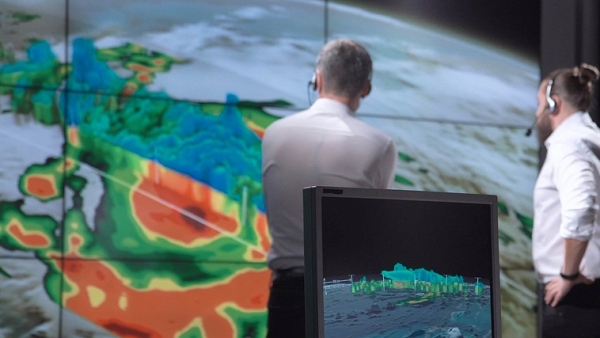
Microsoft has unveiled a new technology that uses AI to improve the accuracy of weather forecasts 2 to 6 weeks ahead. The approach corrects errors in existing forecasting models and can be used without supercomputers, making it likely to help countries that lack weather observation infrastructure.
On Oct. 14, U.S. time, IT outlet The Verge reported that Microsoft researchers developed a machine-learning technique called probabilistic bias correction, or PBC, and published the results in the international journal Nature. It also released related software as open source.
At present, both physics-based weather models and AI prediction models see accuracy drop sharply after about 2 weeks. That is because it is difficult to fully calculate complex interactions between the atmosphere and oceans, and errors caused by a lack of observational data accumulate over time.
Rather than building a new forecasting model, PBC learns recurring errors by comparing past model predictions with actual observations. It then adjusts the predicted probabilities for temperature, precipitation and other variables to increase reliability. It can run on CPUs without high-performance GPUs, reducing the burden of adoption compared with existing AI forecasting systems.
When the researchers applied PBC to the European Centre for Medium-Range Weather Forecasts' physics-based model, performance improved in 98 percent of evaluation items for precipitation and 92 percent for temperature. It also improved in 91 percent of pressure items, and ECMWF's AI forecasting system saw its performance indicators rise by about two times.
A PBC-based forecasting system also achieved the top result in ECMWF's AI Weather Quest competition.
Practical use is also being pursued. Nonprofit research institute Rhiza Research is testing PBC with Kenya's weather authorities with support from the Gates Foundation. It aims to use it for agricultural rainfall forecasts and early warnings for extreme weather events.
Applying the research results reliably to national weather agency operating systems remains a challenge. Microsoft expects that wider adoption of low-cost forecasting technology will increase the use of weather information in agriculture, disaster response and energy management.
 Jae-won Choi
ittt_0801@d-today.co.kr
Jae-won Choi
ittt_0801@d-today.co.kr