
[DigitalToday intern reporter Seung-ah Yoo] Two next-generation Venus exploration missions by the U.S. National Aeronautics and Space Administration, NASA, are gaining momentum as they move up or confirm their launch schedules. They faced possible cancellation and delays due to budget problems, but the United States, Europe and the private sector are expected to pursue Venus exploration in the early 2030s.
On Oct. 14 (local time), IT outlet Ars Technica reported that the DAVINCI Venus atmospheric mission is targeting a December 2030 launch, bringing it forward by 1 year from the previous plan. The VERITAS Venus orbiter secured a budget in line with a November 2032 launch schedule.
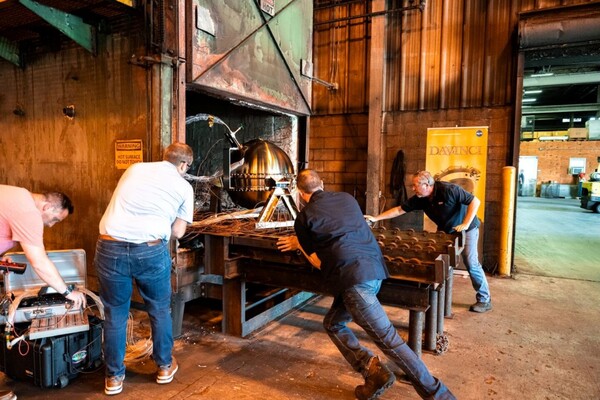
DAVINCI is a mission that will deploy a probe that passes through the Venusian atmosphere using a parachute. During its descent, the probe is expected to capture the first direct images of the Venusian surface since 1982. After a close flyby of Venus in early 2032, it will separate the atmospheric entry probe on Oct. 3 that year. The carrier spacecraft will then follow a trajectory that secures fuel so it can return to Venus and enter orbit.
Jim Garvin (짐 가빈), a planetary scientist at NASA's Goddard Space Flight Center and principal investigator for DAVINCI, said at a recent Venus Exploration Analysis Group meeting that the launch date was moved up by 54 weeks from the existing plan. The DAVINCI team recently tested how the probe's camera and observation instruments collect data during atmospheric descent. Even in extreme temperature tests, it met requirements by keeping the temperature of components inside the thermal insulation structure at 30 degrees Celsius or below. The probe will pass through the atmosphere for about 1 hour and must send observations to Earth via the carrier spacecraft before it disappears beyond the horizon.
VERITAS aims to improve surface maps in detail, following Magellan, a Venus probe launched in 1989 that completed its mission in 1994. Magellan was the first to seriously map Venus' terrain, but its observation resolution was limited. VERITAS plans to improve surface maps with more precise radar and focus observations on active volcanic regions. An official also said it is increasing staffing and speeding up launch preparations. VERITAS is expected to arrive at Venus in mid-2033, slow down using atmospheric drag and begin full-scale observations.
Plans to explore Venus faced a crisis due to budget pressure. NASA considered cancelling VERITAS and also halted support for radar equipment it had planned to provide to the European Space Agency's Venus orbiter Envision. The European Space Agency plans to use a radar it developed itself. It said it was a difficult decision driven by budget constraints.
The European Space Agency is pushing for a 2032 launch of Envision, and private company Rocket Lab plans to launch a probe as early as late 2027 to look for traces of organic material in Venus' upper cloud layers.
Venus is similar in size to Earth, but it is difficult to explore due to an atmosphere mostly made up of carbon dioxide, clouds of sulfuric acid and a surface temperature that reaches 467 degrees Celsius. Its surface topography is also understood less precisely than Mars, and scientists have not clearly identified what caused a runaway greenhouse effect on Venus. If DAVINCI and VERITAS proceed as scheduled, they are expected to secure observations needed to understand Venus' atmosphere and surface.
 Seung-ah Yoo
ysah@d-today.co.kr
Seung-ah Yoo
ysah@d-today.co.kr