
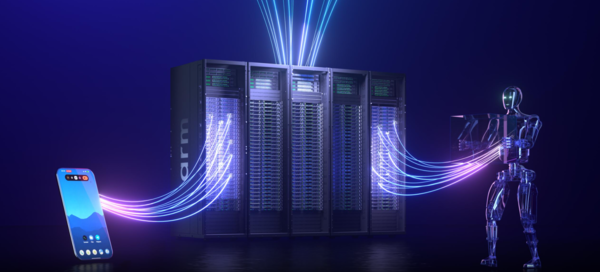
Arm has introduced new CPU performance evaluation criteria tailored to the agentic AI era. Arm said on Oct. 15 it released a benchmarking methodology developed with Fujitsu, Meta and OpenAI.
The goal is to measure systems based on the amount of work an agent actually completes. Arm said a key metric for agentic computing is how many tasks can be completed concurrently while maintaining responsiveness. If throughput drops as utilization rises, the number of completed tasks does not increase even if theoretical processing capacity grows.
The new methodology follows three principles: representative agentic use cases, repeatable CPU measurements and end-to-end result verification. Variables such as model inference and networking are separated into component-level measurements, and end-to-end evaluation checks whether performance improvements translate into task completion results.
Arm also released new independent validation results for its Arm AGI CPU. Signal65 conducted the validation. Signal65 compared AMD EPYC Turin and the Arm AGI CPU across tooling, orchestration, and inference and planning. It applied the same benchmark script to both platforms and said it modeled rack-level performance based on measured server-level performance.
As a result, the company said the Arm AGI CPU showed modeled performance averaging 1.99 times per rack compared with AMD EPYC 9755 across seven workloads. It said this was due to high computing density and power efficiency. By workload, it was 1.7 times for tooling, 2 times for agentic workflow and orchestration, and 2.2 times for inference and planning. The company said sandbox creation latency for an agent to open an isolated execution environment was up to 45 percent shorter than AMD EPYC 9965.
Arm is taking steps to contribute the Arm AGI CPU reference server to the Open Compute Project, an open data center standards group. Meta plans to adopt this CPU in its Yosemite YV5 rack-scale design.
Colin Jarvis (콜린 자비스), head of global forward deployed engineering at OpenAI, said, "AI systems are evolving beyond simply generating responses toward completing complex tasks through reasoning, tool use and interaction with software environments." He added, "As agent capabilities increase and adoption expands, understanding the performance of the infrastructure supporting these workflows, including orchestration and tool execution, is an important industry task." He added, "To identify the characteristics of emerging workloads and optimize performance across entire AI systems, industry collaboration for representative benchmarking will be important."
Toshio Yoshida (요시다 토시오), head of Fujitsu's Advanced Computing Development Division and senior vice president (SVP), said, "As agentic AI advances, evaluating CPU performance requires benchmarks that reflect real workloads beyond existing metrics." He added, "As Fujitsu develops FUJITSU-MONAKA, a next-generation Arm-based CPU with high performance and high efficiency, it recognizes the importance of transparent, reproducible and representative measurement."
 Seok Dae-geon
d2dg@d-today.co.kr
Seok Dae-geon
d2dg@d-today.co.kr