
"It is hard to complete sovereign AI in the true sense with only proprietary AI model development. It is also worth noting that Korea should advance technology so domestically made AI semiconductors can be used not only for inference but also for model training. Korea also needs to secure infrastructure software capabilities to efficiently connect and operate multiple semiconductors to build a Korean-style 'full-stack sovereign AI.'"
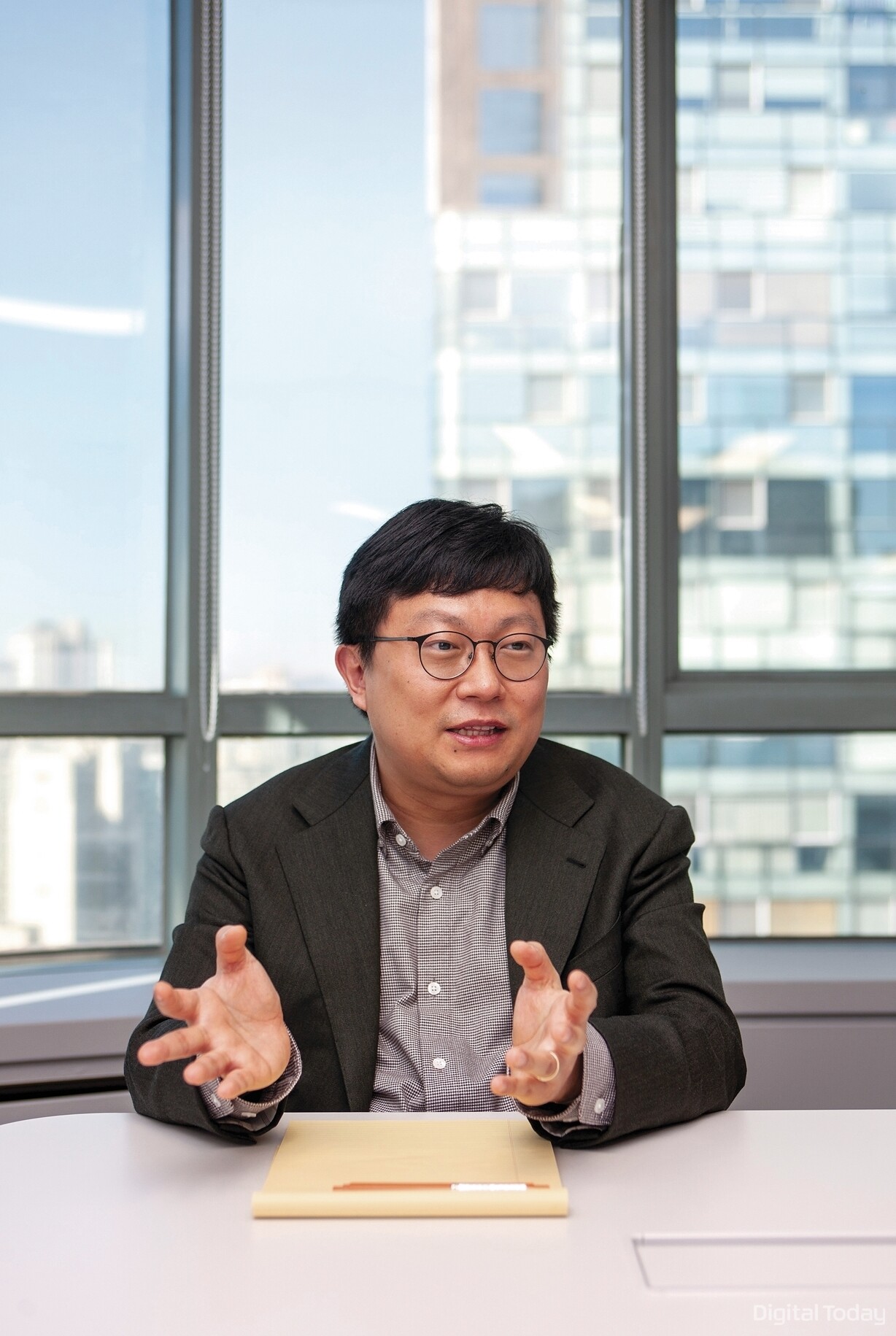
Jo Kang-won (조강원), CEO of Moreh, recently met with a reporter and said Korea is the country closest to having the capabilities to realise sovereign AI, excluding the United States and China. He stressed that Korea needs proprietary technologies not only in semiconductors and models but also in data centres and software.
Moreh is an infrastructure software company that supports the efficient use of AI semiconductors from different manufacturers in a single data centre. It is developing technology to run AI models not only on Nvidia graphics processing units but also on chips from AMD and Tenstorrent. It also optimises computing tasks to lower data centre operating costs.
Jo gave a positive assessment of government policies to develop proprietary AI foundation models and foster domestic AI semiconductors. He said few countries other than the United States and China have so many companies competing in both areas, and that Korea is building a foundation to realise full-stack sovereign AI.
He stressed that developing proprietary AI models is also essential. He said Korea should not assume foreign companies will continue to disclose the latest models indefinitely.
He said, "If we can steadily keep up with the global leading models with a gap of 3 months or 6 months, it will greatly help maintain the competitiveness of domestic companies." He said domestic companies, including Samsung Electronics, should be able to use AI models close to the global leading group while processing sensitive industrial data in their own data centres without sending it outside.
Jo stressed that technological self-reliance should expand beyond AI models to the entire supply chain. He said Korea should build on capabilities it has already accumulated in semiconductors and infrastructure software and also take on the challenge of full-stack sovereign AI.
To do that, lowering dependence on foreign semiconductors from the model-training stage is a task. Nvidia and other foreign GPUs are mainly used for AI model training in Korea. Domestic neural processing unit design companies such as Rebellion and FuriosaAI are also focusing their businesses on the inference market rather than large-scale pre-training.
Jo said it is not technically impossible to train AI models using domestic NPUs. He said domestic chip companies are focusing on the inference market not because training is technically impossible, but because they are making a business judgment to first target a market with relatively clear demand.
He said, "I don't think there is any reason domestic NPUs cannot do training," adding, "From a startup's standpoint, we have no choice but to look at markets with clear demand first, and right now that means focusing on inference."
Training and inference also differ in the criteria for choosing infrastructure. Large-scale model training can delay development schedules for months if it fails, so it tends to prefer proven infrastructure. Inference, by contrast, is about lowering the cost per token, which creates strong incentives to use a variety of semiconductors.
Additional technology development and verification are also needed to use domestic NPUs for large-scale model training. Because multiple semiconductors share computation and repeatedly exchange data during training, not only individual chip performance but also inter-chip communication and the completeness of distributed training software are important.
Jo said, "Training software has far more problems to solve than inference," but he predicted the entry barrier of Nvidia's CUDA ecosystem will gradually fall. Moreh has also internally secured training software technology for Tenstorrent accelerators, but for now it has not gone as far as large-scale training demonstrations as it focuses on demand in the inference market.
◆"Heterogeneous semiconductors can improve cost performance, but clustering is a difficult problem"
Jo cited 'clustering' technology that binds multiple semiconductors into a single large-scale computing system as a key task for realising full-stack sovereign AI. As AI models grow, countless chips must share computation. If data transfer and task coordination do not run smoothly, the overall system performance can drop.
He said Nvidia's competitiveness is expanding beyond the GPU itself to interconnect technologies such as NVLink and NVSwitch. He said that while Nvidia focuses on hardware technology to improve inter-chip connectivity performance, Moreh is focusing on software technology that efficiently operates chips from various manufacturers within a single infrastructure.
Moreh has developed a 'heterogeneous split inference' technology that assigns AI inference workloads across Nvidia H100 and AMD MI300X. In its own tests, under certain high-load conditions it recorded throughput up to 1.67 times higher than a configuration that used only MI300X. Moreh is also reviewing ways to expand this heterogeneous semiconductor support technology to domestic NPUs.
Jo said, "The first thing to break is the perception that only Nvidia works," adding, "Bringing in other semiconductors like AMD and showing they can be used could also help domestic NPUs in the long run."
He added, "No single semiconductor can do every task well," and stressed, "If a domestic NPU can secure competitiveness in certain tasks, it could be a sufficiently large market even if it handles only 5 to 10 percent of a data centre's total workloads."
He said government support methods also need to change to back such market entry. Jo stressed that rather than assigning a quota for the share of domestic semiconductors used, the focus should be on increasing demand for AI tokens produced in Korea. As an alternative, he proposed providing 'token vouchers' to demand-side companies.
He said companies buying tokens weigh price and performance more than the type of semiconductors used for computing. If actual purchase demand is secured, supplier companies will also combine various semiconductors and software to lower costs, he said.
Jo said, "If you create demand, companies will verify and cooperate on their own," adding, "For example, if they can introduce software to raise computing efficiency by 30 percent and produce more tokens to increase profits, they will cooperate on their own even if the government does not tell them to."
 Son Seul-gi
sageson@d-today.co.kr
Son Seul-gi
sageson@d-today.co.kr