
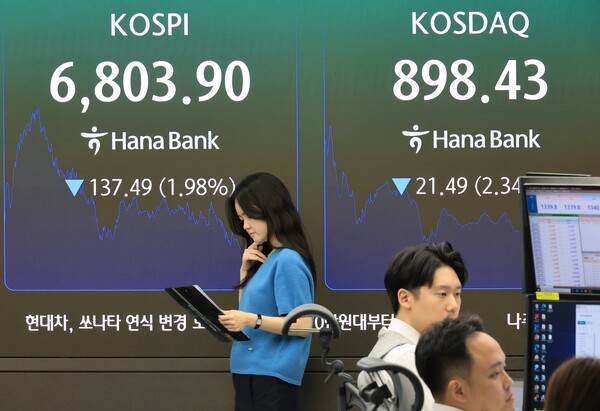
[Digital Today reporter Oh Sang-yup] The KOSPI fell nearly 2% as foreign investors and institutions sold in tandem, sliding to the 6,800 level.
On Oct. 7, the KOSPI closed down 137.49 points, or 1.98%, at 6,803.90. The previous session close was 6,941.39. The index opened down 77.14 points, or 1.11%, at 6,864.25 and then tried to regain the 7,000 level.
Despite gains in U.S. stocks a day earlier, the domestic market showed relatively weak moves. It was seen as driven by concerns over a slowdown in artificial intelligence (AI) investment and ongoing burdens from U.S. interest rates, alongside profit-taking in large semiconductor stocks that had recently lifted the local market.
Foreign investors and institutions led the selling that dragged the index lower. Individuals net bought 2.557 trillion won in the main board market, but foreigners and institutions net sold 2.598 trillion won and 668.4 billion won, respectively.
Most of the top stocks by market capitalisation also weakened. Samsung Electronics closed down 1.29% at 268,500 won, and SK Hynix fell 2.82% to 1,723,000 won.
Elsewhere, SK Square fell 1.64%, Hyundai Motor slid 3.45%, Samsung Biologics dropped 2.52% and Samsung Life Insurance lost 1.40%.
In contrast, LG Energy Solution rose 0.26% and KB Financial Group gained 0.96%.
The Kosdaq posted a bigger drop than the KOSPI. The Kosdaq ended down 21.49 points, or 2.34%, at 898.43, falling below the 900 level.
In Seoul's foreign exchange market, the won was at 1,340.4 per dollar, down 3.2 won from the previous session, showing a similar level.
Recently, the KOSPI has been swinging around the 7,000 level without finding direction. Major sectors such as semiconductors, secondary batteries and biotechnology have taken turns in showing strength, but an analysis says the rally is losing staying power as foreign fund flows do not improve.
Han Ji-young (한지영), a researcher at Kiwoom Securities, said most stock markets are exposed to the same factors, including controversy over a cutback and slower pace in AI investment and rising U.S. interest rates, but only the KOSPI appears relatively weak in additional recovery momentum. She said there is a need to avoid interpreting the recent KOSPI weakness as a weakening of risk appetite in the Korean stock market itself.
She added that as concerns over U.S. rate burdens and rising oil prices are also easing, the KOSPI's relative resilience does not appear likely to weaken further. She said there is a need to open a path for narrowing the performance gap between the domestic market and other markets along with improved foreign flows.
 Oh Sang-yup
yub@d-today.co.kr
Oh Sang-yup
yub@d-today.co.kr