
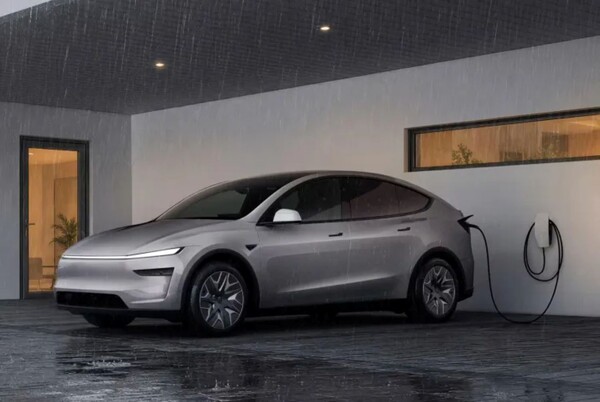
Tesla has expanded support for "Powershare Home Backup" to allow the Model 3 and Model Y to be used as emergency power for homes during outages.
Tesla said on Oct. 6, local time, that the vehicle-to-home (V2H) power supply function, previously offered only on the Cybertruck, is now supported on some Model 3 and Model Y vehicles. It uses an electric vehicle's large-capacity battery like an emergency generator to supply power to a home during a blackout.
Not all Model 3 and Model Y vehicles are eligible. Tesla said Model 3 and Model Y vehicles ordered in the United States and Puerto Rico after Oct. 1 support Powershare, and that some vehicles produced before then can also use it. Actual support depends on the vehicle's hardware configuration.
The function cannot be used with the vehicle alone. To use the Model 3 and Model Y as home backup power, related equipment such as the Powerwall 3 and a Wall Connector is required. Tesla said it plans to provide support for Powerwall 2 and Powerwall Plus later.
Based on the original copy, Powerwall 3 costs about $15,000 including installation, and the Tesla Wall Connector costs $585. Once the full system is installed, the Model 3 and Model Y can supply power to a home.
Backup duration varies by vehicle type and trim. Tesla said the Model 3 Standard and Model Y Standard can provide up to 2 days, while Model 3 and Model Y Premium and Performance trims can extend home backup power for more than 2 days. The Cybertruck can supply power for more than 3 days.
The Cybertruck has a separate power conversion device to supply power, allowing a simpler setup than the Model 3 and Model Y. The Cybertruck can supply power to a home using a Powershare Gateway and a Universal Wall Connector without a Powerwall.
Tesla explained that Powershare can supply power during outages to lighting and small appliances, as well as high-consumption devices such as air conditioners. If a customer already has a Powerwall, the vehicle battery can be used as an additional power source to prepare for prolonged outages.
Bidirectional charging is not unique to Tesla. Some electric vehicles from Chevrolet and Cadillac, as well as the Kia EV9 and Nissan Leaf, also provide functions that use vehicle batteries for homes or the power grid.
With the expanded support, Tesla has broadened its power ecosystem that connects electric vehicles and home energy storage systems to include the Model 3 and Model Y.
 Seung-a Yoo
ysah@d-today.co.kr
Seung-a Yoo
ysah@d-today.co.kr