
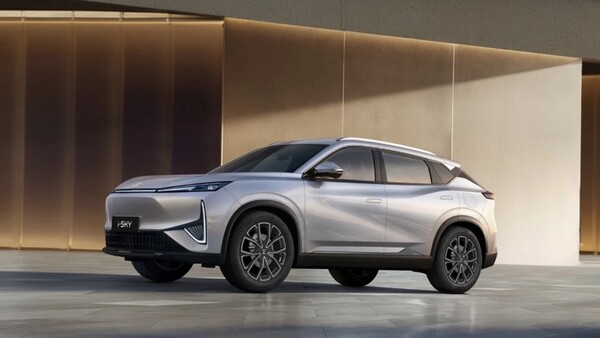
The share of battery electric vehicles (BEVs) and plug-in hybrids (PHEVs) in Russia’s new car market has surged. The shift is seen as demand moving to electric-drive vehicles as gasoline supply disruptions worsened after Ukraine attacked Russian oil refining facilities.
InsideEVs reported on Oct. 6, citing data compiled by Russian auto market research firm Autostat, that BEVs and PHEVs accounted for 11.5 percent of new car sales in one week in late September. That was more than double the roughly 5 percent level at the start of the year. PHEVs made up 8.5 percent and BEVs 3 percent.
Sales volumes also rose sharply. BEV and PHEV sales in Russia in June to August totalled 26,543 vehicles, more than double 12,187 a year earlier. Reuters reported that Russia’s gasoline production fell to about 70 percent of domestic consumption by late August, with some regions facing lines for fuel and continued shortages.
Some have said Russia’s EV market share has surpassed the United States. A simple comparison is difficult. Cox Automotive data showed BEV sales in the United States in August were 78,895 vehicles, accounting for 5.7 percent of new cars, but that figure excludes PHEVs. On a second-quarter basis, U.S. EIA data showed BEVs at 6 percent and PHEVs at 1.4 percent, for a combined plug-in share of 7.4 percent. Given different periods and methods, Russia’s 11.5 percent is best seen as a weekly indicator that has recently run higher than the U.S. level.
The gap remains large compared with major global markets. In the European Union, BEVs accounted for 21.7 percent and PHEVs 10 percent from January to August, for a combined 31.7 percent. In China, the retail share of new energy vehicles in August was 65.2 percent, and BEV sales alone were 698,000 vehicles.
Russia’s recent change appears closer to a case in which unstable fuel supply rapidly spurred demand than an expansion of charging infrastructure. Whether growth continues will likely hinge on vehicle supply, charging networks and whether the fuel market normalises.
 Choi Jae-won
ittt_0801@d-today.co.kr
Choi Jae-won
ittt_0801@d-today.co.kr