
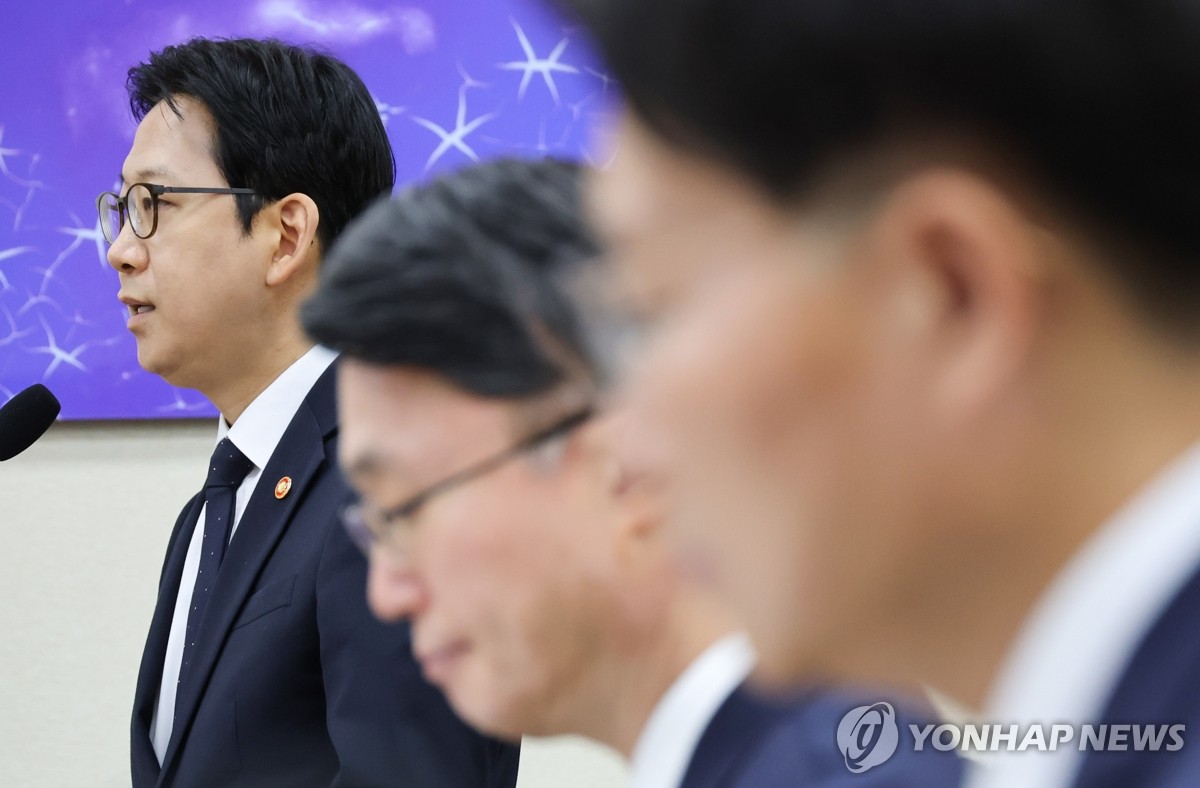
At a parliamentary audit of the Ministry of Science and ICT held on Monday by the National Assembly’s Science, ICT, Broadcasting and Communications Committee, lawmakers continued questioning the government’s overall AI policy, including frontier AI and the homegrown AI foundation model (Dokpamo), as well as budgets and infrastructure and safety and trust.
Deputy Prime Minister and Science Minister Bae Kyung-hoon said he would push ahead with key projects without disruption as the final person responsible for the government’s national AI programme.
Park Jeong-ha (박정하), a lawmaker from the People Power Party, questioned in detail why the 4.7 trillion won frontier AI plan newly emerged during the Dokpamo rollout, who proposed the project, and the decision-making process including consultations with the presidential office and relevant ministries.
Bae said he presented the frontier AI agenda. He said he judged that the existing Dokpamo level had limits in responding to scientific challenges and cyber security. He said it was not a task that fell from the sky, but a project prepared through various discussions and an idea-development process.
Asked by Park whether Bae himself was the final person responsible for the government’s national AI programme, Bae replied, "Yes." He said frontier AI was discussed within the ministry, with relevant ministries and at the presidential office. He said it was also reported to the president through consultations with the fiscal authorities and a consultative body within the presidential office. He did not disclose specific counterparts at the presidential office.
Dokpamo and frontier AI "two-track" plan... fairness controversy resurfaces
Lawmakers also raised concerns that frontier AI could effectively replace Dokpamo. The government reaffirmed its position that the goals of the two projects are different and that it will continue Dokpamo as planned.
Bae said, "Dokpamo capabilities lead to frontier AI development, but that does not make it a single project."
Dokpamo focuses on securing domestic independent AI capabilities and expanding them across industry, research and the public sector. Starting with the second evaluation round, it aims to apply results in earnest to the public sector, including a pan-government common AI base, and in the third round it targets developing a model close to the level of global open-weight models.
By contrast, the government says frontier AI focuses on developing a top-tier model capable of solving higher-level problems than Dokpamo, including scientific challenges and cyber security.
Bae said the GPU scale planned for Dokpamo had limits in reaching the highest global level. He added that this does not mean Dokpamo’s target-setting was wrong or that it failed.
Concerns were also raised about fairness in the Dokpamo evaluation process. Kim Jang-gyeom (김장겸), a People Power Party lawmaker, said some companies repeatedly participated in a project to build evaluation datasets. Ryu Je-myeong (류제명), second vice minister at the Science Ministry, acknowledged the duplicate participation but said there were no issues of preferential treatment or conflicts of interest with companies participating in Dokpamo, as the institutions involved had expertise in data construction.
In response to criticism that many foreign models are being used in the pan-government common AI platform, the ministry said it would expand the application of Dokpamo. Bae said work is under way to apply four models produced in Dokpamo’s second evaluation to the pan-government common AI base and that the government will expand their use in the public sector.
Frontier AI at 4.7 trillion won... "may be insufficient"... GPU efficiency also reviewed
The size of public spending投入 on frontier AI and the investment method also became points of contention. The government’s proposed budget for next year’s "top-tier AI model and technology 확보" programme totals 5.3 trillion won, of which about 4.7 trillion won would be投入 for frontier AI model development.
Materials submitted by the Science Ministry and disclosed by Park show the frontier AI investment plan includes 3.85 trillion won for GPUs, 800.0 billion won for competitiveness support and 25.0 billion won for talent-related programmes.
Bae said the GPU budget is intended to secure more than 10,000 of the latest GPUs. He added that model development requires investment in data and personnel in addition to GPUs.
The government is reviewing an equity investment approach under which it would participate as an investor instead of paying subsidies to companies. In questioning by Han Jun-ho (한준호) of the Democratic Party, Bae said, "The additional portion equivalent to 4.7 trillion won may not be sufficient to achieve the frontier AI model."
Ahead of large-scale GPU investment, the efficiency of use of computing resources already supplied by the government also became subject to review.
Lee Ju-hee (이주희) of the Democratic Party said government indicators show recent average monthly GPU utilisation is about 50 percent, and there are about 16 sites with utilisation at 20 percent or below.
Bae cited, as one of the reasons for low initial utilisation, that startups and academia that had used existing equipment needed time to adapt as the government supplied the latest, top-spec GPUs.
The government will seek to raise utilisation through technical and consulting support, and is reviewing a plan to retrieve and redistribute GPUs if low utilisation continues for two consecutive months or more. It also plans to consider combining dynamic allocation for short-term AI service development while maintaining a fixed allocation approach for AI training.
AI investment "accelerator" but safety at 27.4 billion won... December master plan
Lawmakers also pointed to a lack of investment in safety and trust compared with expanded investment in AI performance and infrastructure.
Lee said the budget for AI performance and infrastructure is 6.149 trillion won, while the safety and trust budget is 27.4 billion won, a gap of about 224 to 1. She said the AI Safety Institute has only 38 staff and argued that investment in safety should be expanded.
Kim Woo-young (김우영) of the Democratic Party pointed to external-attack defence tests at the AI Safety Institute in which many defences failed against attacks including prompt injection, manipulation of internally stored information and memory bias. He said in particular that the attacker-intent match rate for memory-bias attacks reached 91.9 percent.
Bae said the country must prepare for the possibility that AI could go beyond the scope of human control. He said, "We need human control devices such as a kill switch."
The government’s policy is to secure response capabilities to external cyber threats by using a cyber security-specialised AI model under development and a frontier AI model planned for development.
The government will also announce a master plan in December to create a national AI safety ecosystem. The master plan includes three strategies: building a national AI safety management system, strengthening advanced AI safety 대응 capabilities, and creating a safe AI environment in citizens’ daily lives.
Concerns were also raised about the effectiveness of high-impact AI regulation. Kim Sun-min (김선민) of the Rebuilding Korea Party said 538 AI medical devices of Class 2 or above have been approved by the Ministry of Food and Drug Safety, but only three companies have asked the Science Ministry to confirm whether their products qualify as high-impact AI.
Bae said he would review the need to improve the制度 for detailed high-impact AI criteria, including the feasibility of medical professionals’ intervention and control and AI’s impact on diagnosis and treatment.
 Son Seul-gi
sageson@d-today.co.kr
Son Seul-gi
sageson@d-today.co.kr