
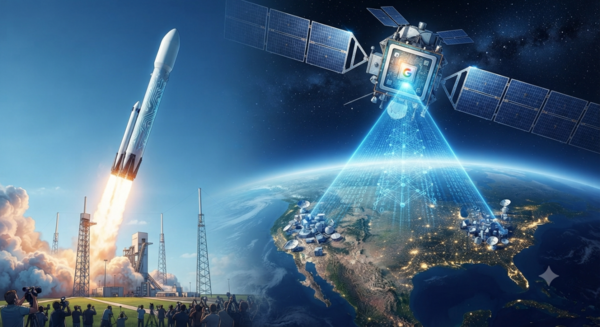
Google has sent a demonstration satellite carrying its TPU into space for the first time, starting verification of an orbital data centre concept.
According to IT outlet TechCrunch on Wednesday, the satellite rode a SpaceX rocket launched from California. It is the first case of Google sending an advanced semiconductor into space.
The demonstration satellite was built by Planet Labs. Google plans to check whether its TPU, which it has developed as a rival axis to Nvidia GPUs, works in the space environment. Key tests include a continuous 1 kilowatt power supply, chip cooling and whether errors occur while running an actual model.
Travis Bils, who oversees Project Suncatcher, said ground tests have already been conducted but cannot fully replace the real space environment. "We tested on the ground, but there is no test as good as the real environment," he said.
Once the satellite begins full operation, the TPU will run in short bursts at 15-minute intervals to reduce the burden of power and thermal management. The current satellite is based on Planet Labs' standard platform, but the two companies are preparing 2 satellites better suited to high-performance computing, with launches targeted for next year. The next vehicles will also test a method of cooperating with each other via laser communication links.
Google's goal does not stop at a single satellite test. The company is, over the long term, envisioning a structure in which 81 satellites fly in formation at close range and perform parallel computing. Bils said bandwidth and latency between satellites are important to combine multiple TPUs to carry out large computations, adding, "We are looking not only at work that exists now but also at work five years from now."
Google said this concept would require launch costs to fall significantly from current levels. A peer-reviewed paper on an orbital data centre that the company released on Wednesday includes conditions for putting computing infrastructure into space. The paper is set to be published in the journal 'Joule'.
Google assumed SpaceX launch prices could, in the long term, fall to about $200 per kilogram. The premise is large-scale repeated operation of Starship. The company calculated that for Starship to achieve a similar level to the cost-cutting trajectory Falcon 9 has built, it would need to put a total of 370,000 tonnes of cargo into orbit. That would correspond to about 1,800 launches over the next 10 years, or 180 launches a year, even assuming 200 tonnes per mission.
The figure is still far from actual results. Starship has never flown more than 5 times in a year. SpaceX projects a much higher launch frequency, but Google's calculation shows that a space data centre is directly tied to launch-vehicle economics beyond being simply a semiconductor issue.
Some of the chip's tolerance to space radiation has been confirmed. Google re-ran particle accelerator tests after reapplying shielding conditions, and judged that while logic-circuit errors increased somewhat, large-scale inference work would be possible over a 5-year satellite lifetime. "For typical inference work, the error rate is very low, at the level of one in a million," Bils said. He added that extremely large training jobs, where thousands of chips run simultaneously for months, could already be a problem.
As a result, Suncatcher's initial focus is likely to be verification of inference and distributed computing rather than AI training in space. Google began the first step of confirming the feasibility of operating TPUs in space with this launch, and cooperation between satellites and lower launch costs are expected to be the next hurdles for its orbital data centre concept.
 Jinju Hong
hongjj@d-today.co.kr
Jinju Hong
hongjj@d-today.co.kr