
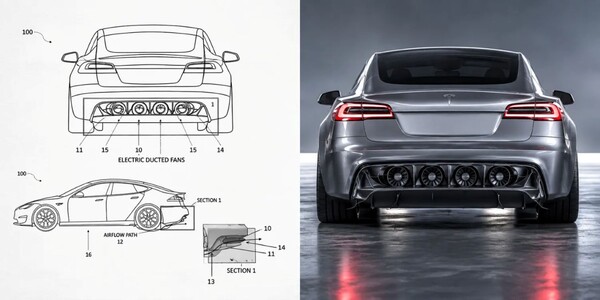
[DigitalToday intern reporter Seung-a Yoo] Tesla has received a registered patent for an “electric fan car” that pulls in air from under the body to press the vehicle to the road surface. It is designed to generate downforce regardless of vehicle speed by placing four electric ducted fans in the rear diffuser.
Electrek, an electric-vehicle outlet, reported on Sept. 29 (local time) that Tesla registered U.S. patent US 12,746,987 B1 for an electric fan car system. Tesla formally filed the patent in January 2024, and the underlying provisional application was submitted on Jan. 17, 2023.
The patent drawings feature a Tesla Model S. Tesla ended production of the Model S and Model X in April, making it unlikely the design will be applied as-is to a mass-produced vehicle.
The core is four axial fans arranged side by side inside the rear diffuser. Air is drawn in through an intake under the body between the rear wheels, sent to the rear through ducts, and the fans discharge air from beneath the floor. Tesla explained that an “intake region” is formed under the vehicle floor in this process.
Tesla also set out the limitations of conventional passive diffusers in the patent document. It said passive diffusers have limited downforce at low speeds and can create excessive loads at high speeds. By contrast, it said using electric fans can create “downforce independent of vehicle speed” to improve braking stability and cornering performance.
It also presented a design to improve airflow. Tesla said that if only a central intake is used, air at the rear of the vehicle can be pulled forward, drawing air from areas other than under the body. In that case, it would not contribute to downforce and would only consume power for the fans. It therefore proposed adding two small side intakes on both sides behind the main intake.
Power to drive the fans is supplied from the same high-voltage battery pack as the vehicle drivetrain, not from a separate battery or motor. The fans are linked to the vehicle control system, and the driver can activate them by pressing a button or the vehicle can be set to activate them automatically at certain speeds.
The patent also draws attention because Tesla has recently been securing patents for aerodynamic technology for high-performance vehicles. Tesla also obtained a fan-car-related patent in August 2025 combining an underbody fan with deployable skirts. Last week it also disclosed a patent for a concealed active rear wing capable of producing up to 700 kg of downforce. The drawings in that patent showed a vehicle similar to the next-generation Roadster.
Attention also focuses on the fact that the drawings for this electric fan car patent were based on the Model S. When the provisional application was filed in 2023, the Model S Plaid was Tesla’s flagship high-performance vehicle, but production has since ended. Interest is therefore growing in the possibility that track-oriented aerodynamics combining fan technology and an active wing could be applied to the next-generation Roadster.
A patent does not necessarily mean mass production. Tesla does not always apply patented technology to actual products. The next-generation Roadster has been repeatedly delayed since it was unveiled in 2017, and a Roadster-related demonstration is currently scheduled for Oct. 15. Whether Tesla will apply the fan technology from this patent to the Roadster is expected to be confirmed during the unveiling process.
 Seung-a Yoo
ysah@d-today.co.kr
Seung-a Yoo
ysah@d-today.co.kr