
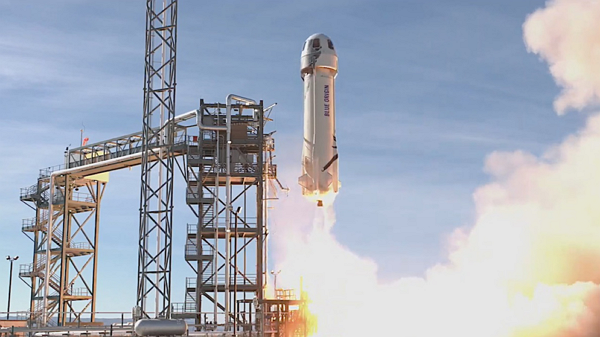
As Tron founder Justin Sun boarded Blue Origin's crewed spaceflight in August 2025, interest has grown in how much space tourism really costs and which services are actually sending passengers to space. Space tourism products range from zero-gravity experiences costing several thousand dollars to International Space Station stays costing tens of millions of dollars. The gap between published price lists and actual operations is being pointed out as a separate issue.
As of Tuesday, blockchain media outlet Cryptopolitan reported the commercial space tourism market is broadly divided into zero-gravity experience flights, stratospheric balloons, suborbital spaceflights and orbital flights involving stays on the International Space Station (ISS). Prices range from several thousand dollars to $55 million (about 74.5 billion won).
The first distinction to make is between products that are being sold and those that have actually flown with passengers. Some companies disclose specific ticket prices but have not yet sent paying passengers to space, or face uncertain schedules due to development delays.
One of the cheapest options is parabolic flight operated by U.S.-based Zero-G. It does not go beyond the atmosphere, but passengers can experience brief weightlessness as the aircraft flies a parabolic trajectory. Each flight performs 12 to 15 parabolas, providing about 5 to 8 minutes of weightlessness in total. Recent seat prices are about $6,700 to $8,850 (about 9.07 million to 12.0 million won). Operations are currently suspended due to maintenance issues.
Tour products using stratospheric balloons have also not yet led to actual commercialization. Space Perspective set a price of $125,000 per seat (about 170 million won) but has not conducted flights carrying paying passengers so far.
The company reached an altitude of about 100,000 feet in an uncrewed test flight in September 2024. It later ran into setbacks and, after leaving its Florida facility in early 2025, was acquired in mid-2025 by Spanish company EOS X Space. For now, it remains an example still in the development stage.
In suborbital spaceflight, Blue Origin and Virgin Galactic are representative. Both have a record of sending passengers to the boundary of space, but regular crewed operations are currently suspended.
Blue Origin's New Shepard has flown 38 times, sending 98 people beyond the Karman line. Jeff Bezos, William Shatner, Oliver Daemen and Katy Perry have flown. Blue Origin said it will halt New Shepard flights for at least 2 years from Jan. 30, 2026, to focus on developing its Blue Moon lunar lander. That makes it difficult to view it as a product where a seat can be purchased and used immediately at this point.
Sun's case also differs from a typical ticket purchase. He won a seat auction for Blue Origin's first crewed flight in 2021 with a bid of $28 million (about 38.0 billion won) but delayed flying due to scheduling issues. He later flew on Aug. 3, 2025, on the New Shepard NS-34 mission.
The $28 million Sun paid at the time was also not a standard fare applied to ordinary passengers. The amount was a one-off payment in the nature of a donation to Club for the Future, Blue Origin's charity. An official ticket price for the general public has not been disclosed.
Virgin Galactic has a track record of carrying paying passengers. It conducted six paying-passenger flights from 2023 to 2024 and reached an altitude of about 86 km. That does not meet the widely used international boundary of space at 100 km.
Virgin Galactic resumed ticket sales for spaceflight in April 2026, setting a price of $750,000 per seat (about 1.0 billion won). More than 675 people are reported to remain on a waiting list.
But its existing spaceplane VSS Unity was retired in 2024. The target for the first flight of its next-generation Delta-class spaceplane was also pushed back from the fourth quarter of 2026 to February 2027. That is also only a target set by the company, not a confirmed schedule for commercial operations.
Prices rise sharply when moving to orbital flights that actually stay in space. In private orbital flights involving stays on the ISS, Axiom Space is a representative operator. Axiom has carried out four private ISS missions, from its first, Ax-1, in 2022 through Ax-4 in 2025.
The per-seat cost is known to be about $55 million. Unlike suborbital flights that simply go up to the boundary of space and return, orbital missions remain on the ISS, resulting in a large price difference.
NASA has approved Axiom's follow-on private mission, Ax-5, with a launch target after January 2027. Separately, NASA assigned a private spaceflight mission to Vast in February 2026, leaving open the possibility that the commercial spaceflight market using the ISS could expand to other operators.
SpaceX also has a track record of crewed private spaceflights for civilians. Inspiration4 and Polaris Dawn are among representative missions. These missions were conducted as private projects rather than selling fixed-price seats to general consumers.
Among space-related services with a relatively unusual track record are memorial spaceflights. Celestis has conducted 24 memorial flights since 1997. It places a portion of remains or DNA samples, rather than a full set of ashes, in a capsule and flies it as a payload on a launch vehicle.
Prices start at $3,495 for suborbital round-trip products, and at $4,995 (about 6.76 million won) for Earth-orbit products. It differs in nature from tourism that sends people directly to space, but it forms another axis of the market as a commercial space service with an accumulated launch record.
Safety is also a task the space tourism market must address. Virgin Galactic lost co-pilot Michael Alsbury in an accident during a test flight in 2014. Blue Origin also had a booster anomaly shortly after launch on its uncrewed cargo mission NS-23 in 2022, but its escape system activated and the payload was recovered by parachute. There were no crew casualties in the incident.
Each operator requires pre-flight medical evaluations, but the industry is not at the stage of having safety statistics accumulated through large-scale operations like commercial aviation. With flight numbers and passenger counts still limited, operating track records and safety are cited as key factors for judging space tourism services, along with price.
Ultimately, in the current space tourism market, verifying whether you can actually fly now is as important as how much it costs. Products have emerged ranging from zero-gravity experiences costing several thousand dollars to ISS stays costing tens of millions of dollars, but some remain in development or have suspended operations.
A glossy price list and a reservation page do not immediately mean an actual flight. As Sun's case shows, it can take a long time to reach an actual spaceflight. Competition in the space tourism market is expected to become more important not only over prices but also over the ability to operate regularly, safety and actual passenger flight track records.
 Jinju Hong
hongjj@d-today.co.kr
Jinju Hong
hongjj@d-today.co.kr