
With pay-TV competitiveness weakening and potentially shaking the investment and distribution base for K-content, a proposal has emerged calling for pay TV’s role to be redefined as a key infrastructure supporting the domestic media ecosystem. It argues that operator-specific regulations should be reorganised around services and that greater autonomy over pricing, products and channel lineups is needed to restore platform competitiveness.
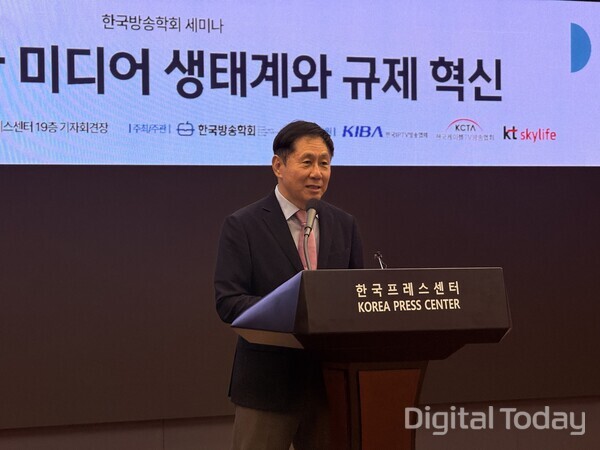
Hong Jong-yoon (홍종윤), a professor in the Department of Communication at Seoul National University, stressed at an "Integrated Seminar for a Sustainable Media Ecosystem and Regulatory Innovation" held on Tuesday at the Korea Press Center in central Seoul, "Enhancing pay-TV competitiveness should not simply be about defending subscribers, but about strengthening and maintaining the platform’s inherent functions."
The seminar was jointly hosted by the Korea IPTV Broadcasting Association, the Korea Cable TV Broadcasting Association and KT Skylife, together with the Korean Association for Broadcasting and Telecommunication Studies. It was organised to diagnose the crisis in the pay-TV industry and discuss directions and implementation tasks for regulatory restructuring to restore platform competitiveness.
Hong defined pay TV as a "core media platform" that connects domestic content with users and supports broadcasting funding sources and media diversity. He explained that falling subscriber numbers and worsening profitability could spread beyond individual operators’ management difficulties to the broader content ecosystem.
In particular, he said that if pay-TV platforms weaken, distribution outlets for small and midsize programme providers and local channels could shrink. He also said domestic content companies’ capacity to invest and their bargaining power with global platforms could decline. He also raised the possibility that user data and points of contact for content consumption could become concentrated on global platforms, and that viewing accessibility for older people and vulnerable groups could weaken.
According to Hong, broadcast channel provision revenue paid by pay-TV platforms to terrestrial broadcasters and general programme providers in 2024 totalled 1.56 trillion won, accounting for 21.7 percent of those operators' broadcasting business revenue. Retransmission fees paid by pay-TV platforms to terrestrial broadcasters amounted to 456.9 billion won, about 13 percent of their broadcasting business revenue.
Hong said the unit of media competition has shifted from individual channels or operators to ecosystems encompassing content, platforms, data and points of contact with users. He said domestic regulation remains divided around transmission means and operator types.
He proposed shifting the basic unit of policy from broadcasting operators to audiovisual media services, and regulating by distinguishing the functions of content and networks. He said the same regulation should apply to the same function, while responsibilities should be differentiated according to market influence and public interest. He also said prior regulation in the private sector should be reduced, while post-hoc regulation for user protection and fair competition should be strengthened.
He also called for innovation within pay TV itself. He stressed that services should expand beyond simple channel delivery to integrated search, AI-based recommendations, personalisation and integration with over-the-top services. He said a structure should be created in which stronger platform competitiveness leads to content investment through joint investment in domestic content and joint projects with small and midsize production companies and programme providers.
Noh Chang-hee (노창희), head of the Digital Industry Policy Research Institute, who delivered the second presentation, offered specific regulatory improvement tasks including pricing, channel lineups and licensing approvals.
Noh proposed changing pay-TV user fees from a filing that requires authorities’ acceptance to a "self-contained filing system" under which effectiveness arises from filing alone. He also proposed shifting bundled products from requiring approval to being subject to filing. He said autonomy in product design should be expanded so that operators can offer products allowing individual channel selection or small bundles.
He proposed gradually scaling back regulations on mandatory channels and abolishing them over the medium to long term, while supporting public channels through support measures and incentives. He also listed tasks including simplifying re-licensing reviews, considering a shift to a registration system, reducing conditions attached to licences, and easing regulations on broadcast advertising.
Yoo Yong-hwa (유용화), head of the Korea IPTV Broadcasting Association, said in congratulatory remarks, "For more than 10 years, we have talked about an integrated media law and a reorganisation of the regulatory framework." He added, "We need to create an environment in which the domestic media industry can invest and innovate again."
 Seulgi Son
sageson@d-today.co.kr
Seulgi Son
sageson@d-today.co.kr