
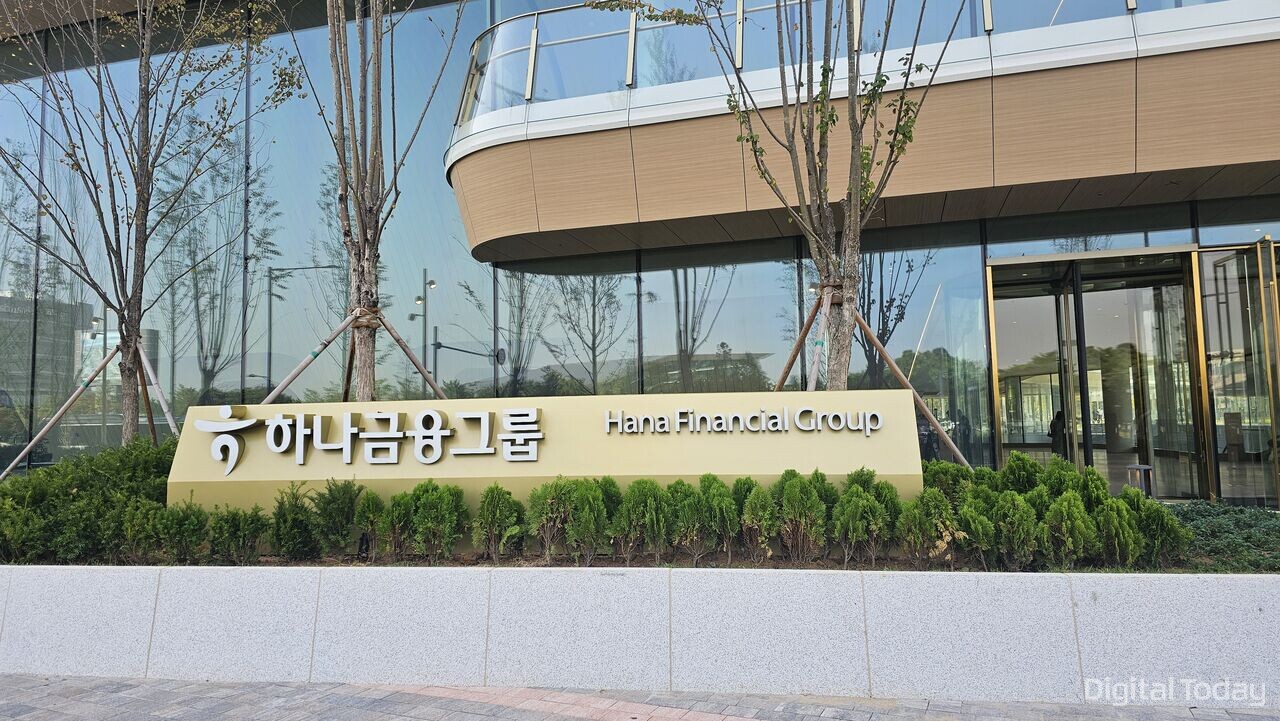
[Digital Today reporter Ji-young Lee (이지영 기자)] The interior was as striking as the exterior that draws attention from afar. With expansive work areas, stairways linking floors and a wireless environment that lets staff work anywhere with just a laptop, Hana Financial Group’s Cheongna headquarters brings together financial and digital capabilities.
Hana Financial has begun moving into the Cheongna headquarters, opening a full-fledged "Cheongna era". The group is not simply relocating its workplace to Incheon. It is changing how affiliates work together in one space and linking the site with a nearby integrated data centre. Cheongna
Hana Financial Group’s Cheongna headquarters in Cheongna International City, Incheon, which was visited on Tuesday, felt far more overwhelming than in photos. The building’s distinctive shape, visible from afar, first caught the eye.
Inside, the atmosphere shifted again. An open layout that minimises visual barriers and high ceilings made it hard to feel like it was a cramped office. Curves used throughout the structure softened the rigid feel typical of large office facilities, and movement between spaces also flowed naturally. That is why the vast interior felt light rather than heavy.
Hana Financial began work at the Cheongna headquarters on Sept. 14 for all Hana Financial Group Inc employees and some employees of Hana Bank and Hana Financial TI. All employees of Hana F&I moved on Sept. 21. Hana Bank and Hana Capital will follow in October, while Hana Life Insurance, Hana Securities, Hana Fund Service, Hana Card and Hana Savings Bank are set to move in stages from November.
Once the relocation is complete, about 2,200 employees from 10 affiliates will newly join Cheongna. Including existing Cheongna staff, about 4,000 finance workers will be gathered in one place. That means Cheongna will become not just Hana Financial’s new office building but another central axis for the group as a whole.
◆ Linking teams on a 3,636-square-metre floor… building collaboration into the space
The clearest keyword running through the Cheongna headquarters is "collaboration". Built from seven basement levels to 15 floors above ground with a total floor area of 128,503 square metres, the building focused from the design stage on lowering physical boundaries between departments and affiliates. Instead of subdividing offices into many small sections, it allows organisations to connect naturally within broad spaces.
The dedicated area per work floor is about 3,636 square metres. That is about 3 times larger than the existing Myeongdong office building. The difference is hard to grasp from the numbers alone, but it becomes clear upon entering the work floors. Work areas stretch so long they are difficult to take in at a glance, and open spaces throughout do not block the view.
Not every work area could be seen directly, but the desk layout and space configuration made it easy to read a design that has communication between organisations in mind. The high ceilings, openness and use of curves in the layout stood out.
What stood out most was the view outside the windows. Past the broad work areas, the West Sea spread out. It was explained that the sea appears even clearer on days with good weather. The open view overlooking the sea created an atmosphere clearly different from what is typically associated with a bleak office.
The space is not only wide horizontally. The floors are also actively connected. The Cheongna headquarters has internal stairways connecting floors 3 to 7 and floors 10 to 14. It changes the existing office flow in which employees take elevators to their floors and spend the day at assigned seats.
Moving on the internal stairs naturally brings employees into contact with colleagues on other floors. Even without scheduling a meeting, conversations can start while moving, and unexpected encounters can lead to new ideas. The space itself is structured to create points of contact among employees.
Communication zones where employees can naturally meet and talk during work were expanded by about 3 times compared with the Myeongdong office building. That is why Hana Financial describes the Cheongna headquarters not as an "office" that simply accommodates people but as a "collaboration platform" that connects them.
Digital infrastructure has increased the freedom of the space. Hana Financial built a 5G wireless work environment at the Cheongna headquarters, which it described as the first in the financial sector. Using cloud PCs (VDI), messaging and softphones, it enabled employees to work while moving around with laptops rather than being tied to wired networks or specific seats.
Seats, meeting rooms and even welfare facilities can be reserved via app and web. Employees choose the places they need that day to suit their work style. The meaning of having "my seat" inside the building has become weaker than before, while "where, with whom and what work to do" has become more important.
It is not filled only with space for work. The staff cafeteria is located on floors 8 and 9 in the building’s central area. Floor 8 operates a Western food section and floor 9 a Chinese food section, broadening choices. Placing the cafeteria in the centre of the building also suggests that employees’ daily routines and rest were considered important elements of the spatial design.
A takeaway area for ready-to-eat meals was set up on the first basement level. Along with a tenant cafe, fitness facilities cover about 661 square metres. It has 4 sports massage rooms, 8 recliner chairs, 60 capsule rooms and a health room. The building brings not only work space but also the rest and daily life of employees who spend a large part of their day at the company into the office.
◆ Next to the headquarters is the group’s IT heart… even unseen finance moves to Cheongna
It is not only people and office space gathering in Cheongna. Near the headquarters is Hana Financial Group’s integrated data centre, which opened in 2017. It is the first in South Korea’s financial sector to bring a financial group’s human and physical IT infrastructure together in one place, and it serves as the group’s digital heart by integrating and operating core IT systems for affiliates such as banking, securities and cards.
The integrated data centre spans one basement level to 16 floors above ground with a total floor area of about 66,000 square metres. It comprises a welcome centre for visitors, a core centre housing major servers and IT infrastructure, and a vision centre where IT specialists work.
Unlike the flashy and open headquarters, the moment one enters the data centre the atmosphere completely changes. The first thing felt is strict "control".
Entry routes for employees and external visitors are separated from the start. External visitors must pass an entry system that allows only one person in at a time. The process also detects weight. It was explained that the system was designed to immediately block access if the detected weight differs between entry and exit.
A tour of the situation room, electrical room, battery room and server facilities made it clear why the site is called the group’s core IT facility. The scale of the massive equipment was substantial, but what was felt first was the intensity of security.
The entire data centre is a security zone, so taking photos inside was not allowed. Access management was also strict enough that deviating from the designated route during movement would require going through the entry process again.
At its centre is an integrated security control centre. The centre monitors and analyses cyber threats in real time to protect the group’s IT services and financial information. It was explained that operations began as hacker group activity expanded and the need for joint group-level response, rather than affiliate-by-affiliate 대응, grew.
A Hana Financial official said that, through continuous operations and upgrades, 35 security experts as of 2026 are responsible for security monitoring for 22 affiliates, including overseas units. The official said the centre collects more than 1 billion pieces of data a day and selects more than 50 million items daily based on importance, risk and impact.
The official added that detailed analysis by security experts identifies about 400 actual hacking attacks a day.
The process of collecting more than 1 billion pieces of data a day, selecting more than 50 million based on risk and then filtering out real attacks through detailed analysis shows another reality brought by the digitalisation of finance. From the user’s perspective, countless systems and security staff are operating 24 hours a day behind mobile banking transactions that finish in seconds.
The role of the data centre is no longer limited to safely operating servers. The cloud integrated operations centre monitors the group’s private cloud and external public clouds 24 hours a day. In the same space is the Hana Financial Convergence Technology Institute, which is responsible for the group’s AI research.
At the institute, it researches technologies needed in the financial industry, including data analysis, AI investment strategies, natural language processing, image and document recognition, and blockchain. The research results are being applied to actual services such as customised asset management, credit evaluation, automated counselling and financial document processing. That is the background to Hana Financial describing the integrated data centre as the centre of a digital finance innovation system that runs from infrastructure to cloud to AI.
◆ Building an AI data centre on the seventh floor… also pursuing a second data centre
The integrated data centre’s AI infrastructure is also set to expand. Hana Financial is currently working to convert space on the seventh floor of the integrated data centre into a computer room for an AI data centre. Hana Financial said the work will take about 2 years and the related facilities are expected to be completed around August 2028.
Separately, it is also pushing to build a second data centre. A Hana Financial official said it is operating a task force related to the AI data centre and plans to announce a plan for the second data centre within a year.
The official added it is considering building it at a location at least 30 km away from the existing centre, taking into account disaster recovery. The official also said many companies and financial firms have recently been focusing on securing data centre infrastructure to operate AI systems.
Hana Financial does not plan to leave the Cheongna headquarters as a space only for employees. It plans to hold cultural and sports events for the Incheon area in the future and develop it into a representative group space visited by domestic and overseas individual and corporate customers.
 Ji-young Lee
ljy@d-today.co.kr
Ji-young Lee
ljy@d-today.co.kr