
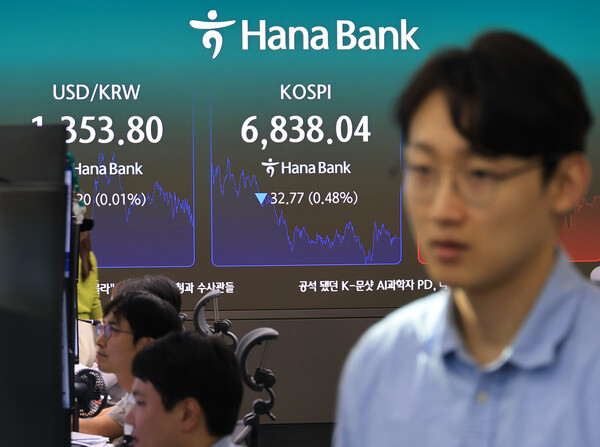
[Digital Today reporter Sang-yeop Oh] South Korea’s KOSPI fell for a third straight session on Sept. 30, weighed by a sharp rise in U.S. Treasury yields. Early gains faded and the index turned lower as foreigners and institutions sold together.
The KOSPI closed down 32.77 points, or 0.48 percent, at 6,838.04. It opened up 72.66 points, or 1.06 percent, at 6,943.47, but turned lower in the afternoon as foreign and institutional selling expanded and slipped to the 6,800 level during the session.
In the KOSPI market, individuals posted net buying of 978.2 billion won. Foreigners and institutions posted net selling of 1.45 trillion won and 1.18 trillion won, respectively, pulling the index lower.
Top market-cap stocks were mixed. Samsung Electronics closed down 1.47 percent at 268,500 won.
Samsung Electro-Mechanics fell 0.98 percent, Hyundai Motor slipped 1.43 percent, KB Financial dropped 2.71 percent and Samsung Life declined 2.93 percent.
SK hynix rose 0.62 percent to 1,776,000 won. SK Square gained 1.88 percent, LG Energy Solution added 1.28 percent and Samsung Biologics rose 0.43 percent.
The KOSDAQ closed up 6.11 points, or 0.72 percent, at 855.91.
In the Seoul foreign exchange market, the won was at 1,353.70 per dollar as of 3:30 p.m., up 0.20 won from the previous session.
Domestic stocks rose early, influenced by a rebound in U.S. semiconductor shares. U.S. stocks weakened overnight as the 10-year Treasury yield rose above 5.29 percent during the session, but pared losses late as yields eased and investment sentiment in artificial intelligence-related shares recovered somewhat. The Philadelphia Semiconductor Index rose 1.32 percent and Micron gained 1.05 percent.
Han Ji-young (한지영), an analyst at Kiwoom Securities, projected that foreign selling linked to end-of-quarter rebalancing could continue but its scale would be limited compared with the second quarter.
She said that with the third-quarter performance gap between U.S. stocks and bonds narrowing compared with the second quarter, downward pressure to cut equity exposure from asset-allocation adjustments could be relatively lower.
 Sang-yeop Oh
yub@d-today.co.kr
Sang-yeop Oh
yub@d-today.co.kr