
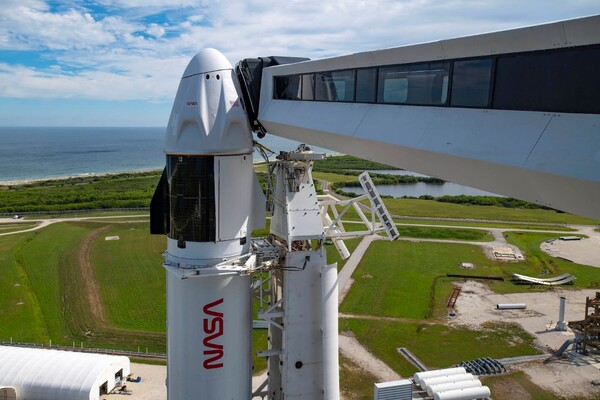
SpaceX has told the U.S. space agency NASA that it intends to stop low Earth orbit crewed missions using Crew Dragon and Falcon 9 after 2030.
On Sept. 29 (local time), IT outlet Ars Technica reported that SpaceX will continue supporting the International Space Station (ISS) through 2030 but plans to retire Crew Dragon after that. SpaceX also told low Earth orbit private space station developers including Axiom Space, Voyager Space and Vast Space that it will not provide Crew Dragon missions.
The decision is expected to affect NASA's low Earth orbit commercialisation plan, which it has pursued for about 20 years. NASA has built a low Earth orbit ecosystem extending beyond space station transport to include private space stations, space manufacturing and tourism. The retirement of Dragon, a key crewed transport system, could also disrupt efforts to secure transport needed to operate private space stations.
NASA would also find it difficult to force SpaceX to keep flying. NASA spent $3.1 billion through its commercial crew program to develop and certify Crew Dragon, but SpaceX was contractually required to carry out about 6 missions. SpaceX has already flown 13 crewed missions for NASA, with additional missions scheduled. It has been flying beyond its original contractual obligations after agreeing to continue flights through the Crew-17 mission.
Behind SpaceX's decision is a change in its profit structure. SpaceX currently earns most of its revenue from Starlink, and financial materials disclosed during its push for an initial public offering identified Starlink and an orbital data centre as key future profit sources. NASA Administrator Jared Isaacman (재러드 아이작먼) said at a news conference on Sept. 28 that SpaceX appears to be seeking to phase out existing platforms such as Falcon and Dragon as it focuses on next-generation capabilities such as Starship.
Still, Starship is unlikely to be an immediate alternative. Starship has the potential to carry dozens of astronauts at a time, but SpaceX has told NASA it has no interest at present in developing Starship for crewed launches to low Earth orbit. Crewed ascent and re-entry raise safety and regulatory issues, and NASA's priority is also focused on securing a Human Landing System (HLS) for the Artemis lunar program.
That leaves NASA in a position where it has little choice but to rely more on Boeing's Starliner. NASA decided this week to invest an additional $359 million to improve Starliner's propulsion system and to support crewed-launch certification for the Vulcan rocket. It also decided to order two more Starliner crewed missions. NASA plans to use Starliner to transport astronauts while the ISS remains in operation, and later make it available to private space station operators as well.
The problem is price and operating performance. NASA has so far invested $5.1 billion in Boeing, but Starliner has yet to carry out a single regular ISS operational mission. The per-seat price is around $90 million, higher than $55 million for Dragon's early missions and $78.8 million for recent missions. It is also difficult to expect prices to fall after Dragon is retired.
There are no obvious alternatives in the near term. Blue Origin, founded by Jeff Bezos (제프 베조스), is developing a crewed spacecraft to fly on its New Glenn rocket, but its first crewed flight is discussed as being no earlier than 2031. India's Gaganyaan has been pushed back to at least 2027 and is likely to be prioritised for India's own missions for the time being. A crewed spacecraft being developed by Europe's The Exploration Company is expected to be ready only around 2035. Orion is difficult to view as a realistic low Earth orbit transport alternative given its high per-seat cost and its use for lunar missions.
As a result, in the early 2030s the Western crewed transport available to NASA and private space station operators is increasingly likely to depend heavily on Starliner. SpaceX's Dragon retirement is also expected to change competitive dynamics in the crewed transport segment of NASA's low Earth orbit commercialisation plan.
 Seung-a Yoo
ysah@d-today.co.kr
Seung-a Yoo
ysah@d-today.co.kr