
Companies are increasing investment in AI agent-based work innovation that automates specific tasks without human intervention, known as agentic AI transformation (AX). Some say implementing agentic AX is harder than expected. Experts commonly point to results from pursuing agentic AX without proper preparation.
DigitalToday held its Digital Insight 2026 conference on Sept. 29 at COEX in Samseong-dong, Seoul, under the theme of “Agentic AX global trends and success strategies.” Government and corporate experts took part and shared practical experience on agentic AX based on real-world work.
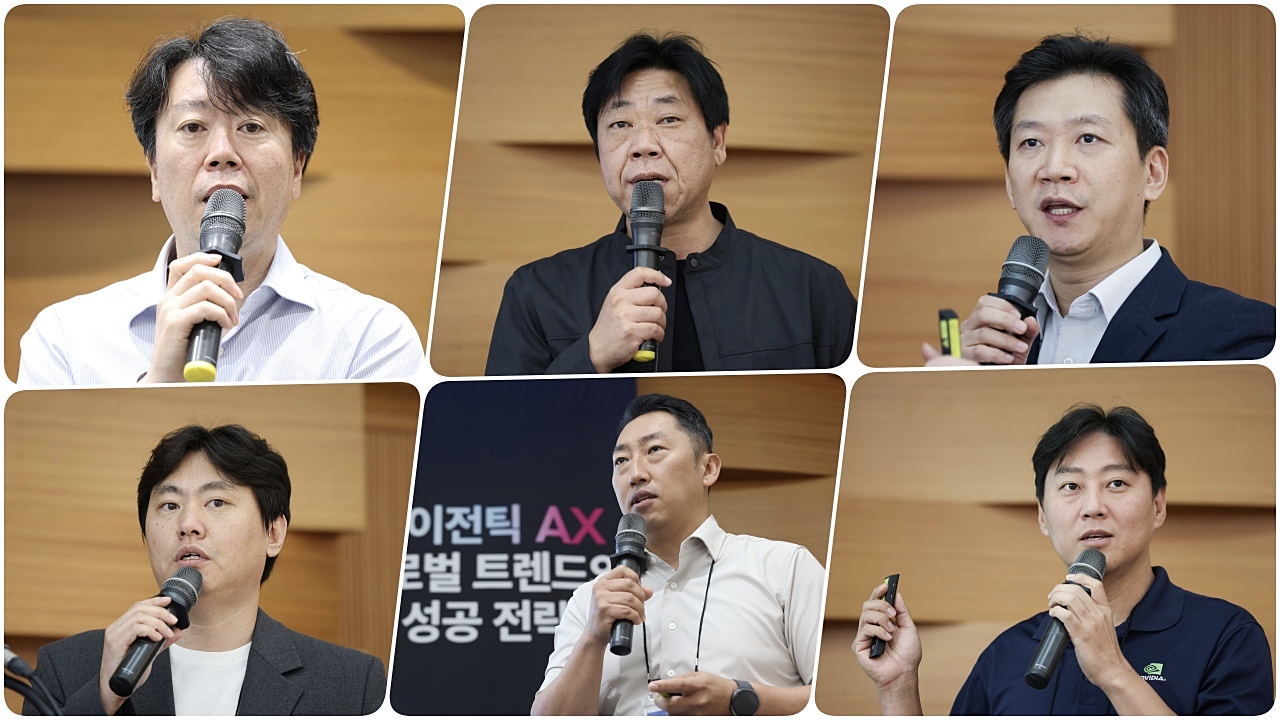
Experts from SK Telecom, MegazoneCloud, Hana Bank, Encoa, Nol Universe and Nvidia Korea took part in the event and introduced agentic AX trends and application strategies.
Tae-yoon Kim (김태윤), vice president in charge of foundation models at SKT, highlighted that local models, or models companies can control, have a significant advantage in turning nuanced industry-site knowledge into assets.
SKT: Industry-site knowledge is AI competitiveness... acceleration of proprietary model advancement
Kim said AI model trends are quickly shifting toward agent-based working AI. He forecast that AI technology will move beyond simple Q&A and code writing, and develop after 2027 into multi-agent systems in which multiple AIs divide roles and carry out tasks.
Han-soo Kim (김한수), executive director of MegazoneCloud’s AIR Unit, stressed that to embed AI agents in real work, companies must first clearly define the tasks to delegate and the scope of authority, before focusing on technical implementation.
He said AI agents should be onboarded into organisations only after standards for tasks and responsibilities are set, just as new employees are not given corporate cards and full internal-system permissions on their first day.
Corporate AI agents: “Controllable autonomy” is key
Woo-seop Lee (이우섭), head of the Digital Strategy Business Division at Hana Bank, introduced the bank’s AI build-out cases and future strategy. Hana Bank is pursuing both external commercial AI and in-house AI running on an internal network, taking into account a regulatory environment unique to finance, such as network separation and personal data protection. He said in-house builds allow use of internal data without exporting it externally, but come with a heavy burden for infrastructure construction, operations and maintenance.
Hana Bank advances in-house financial AI search... sharply raises search success rate
Lee said that even if AI use expands in the financial sector, the core is trust and control. He said the bank will view financial regulation positively and continue to consider what to do and how to proceed within that regulatory environment.
Ki-dong Kim (김기동), a team leader at AI and data specialist Encoa, cited the level of data preparedness as the biggest reason AI agent adoption results differ by organisation. He said that for an agent to properly use corporate data, it must first be told the meaning of the data and how it connects with other data.
Agentic AX? Build AI-ready data now
He said AI models and technology will keep improving. He said what an agent uses and how it makes judgments will depend on how much companies have prepared, stressing the importance of an AI-ready data strategy.
Ju-bong Yoo (유주봉), a leader at Nol Universe, shared internal AX cases and results under the theme of the company’s internal AX transformation period. Nol Universe decided to change internal work before launching AI services for B2C users, judging that there is a lot of manual work at operational sites in its travel, leisure and culture businesses.
Nol Universe: Front-line teams improve work with AI... applies 97 AX tasks
Yoo said partners such as affiliates and performance planning agencies send documents in different formats, forcing employees to cross-check and re-enter information. He said some tasks were small in scale and were pushed down the development priority list. He said it was also too difficult to replace the work if a person in charge left. He said the company pursued internal AX from the idea of first changing the way it works before moving to B2C.
Sun-wook Kim (김선욱), an executive director at Nvidia Korea, said he receives many inquiries asking whether companies can rent computers because they lack computing resources, showing that companies are using agent AI a lot. He stressed that an agent must run many linked components such as tools together, and that a real agent runs under orchestration.
A real agent is AI that works on its own under orchestration
He also stressed that agents are an infrastructure issue. Kim said agents can run only when CPUs, GPUs and storage servers are tied together as a single infrastructure, and that what moves that infrastructure is power. He said agents can be run within the range allowed by energy.
 Chi-gyu Hwang
delight@d-today.co.kr
Chi-gyu Hwang
delight@d-today.co.kr